An Oʻahu broker’s perspective on supply, demand, and buying or selling while mortgage rates remain elevated. Data and forecasts reviewed October 7, 2026
I see reasons to be cautiously optimistic about real estate in 2027 and 2028. My expectation is a gradual improvement in the ability of buyers and sellers to make a move, supported by more choices, realistic pricing, and some improvement in household purchasing power. That would be welcome progress for consumers and for the agents helping them.
As Broker-in-Charge at Hawaiʻi Life’s East Oʻahu office, I want our conversations about the market to begin with the property, the people, and the numbers. Mortgage rates deserve close attention. They should not become the only factor in deciding whether a move makes sense.
Supply and demand still rule the day. The key is understanding both sides: how many suitable homes are available, and how many buyers are willing and financially able to purchase them. Interest rates influence that balance, along with income, ownership costs, location, and the reasons people need to move.
What the National Numbers Show
Here is the national existing-home picture for August 2026, according to the National Association of REALTORS®:
| National measure | August 2026 | Comparison |
|---|---|---|
| Existing-home sales pace | 3.98 million annually | Down 1.2% from August 2025 |
| Homes available for sale | 1.62 million | Up 5.9% from August 2025 |
| Inventory relative to sales | 4.9 months of supply | 4.6 months in August 2025 |
| Median existing-home sale price | $429,100 | Up 1.6% from August 2025 |
| Distressed share of sales | 2% | Unchanged from August 2025 |
The sales figure is a seasonally adjusted annual pace. The report covers single-family homes, townhomes, condominiums, and co-ops. nar.realtor
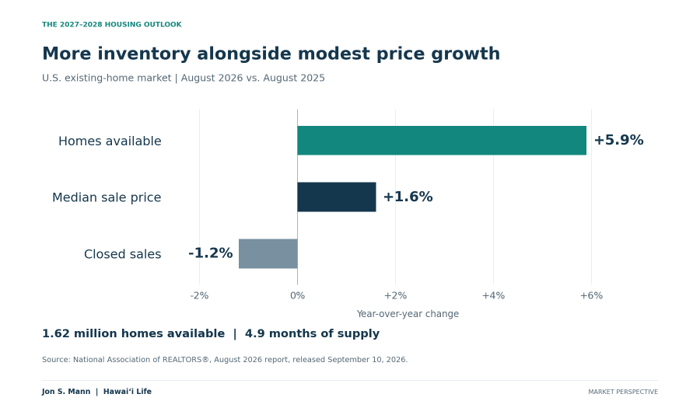
Chart 1. Source: National Association of REALTORS®, August 2026 report, released September 10, 2026.
My reading is that buyers have gained options while sellers continue to find a functioning market. A slower sales pace and a modestly higher median price can coexist. Neither statistic tells us what a particular home should sell for, and a median can change when the mix of properties sold changes.
These are August closings. They precede the latest increase in mortgage rates and cannot tell us its full effect. Still, they provide a useful starting point for a discussion grounded in conditions rather than anxiety.
Supply and Demand Include the Monthly Payment
There are two different supply questions. One is how many homes a buyer can choose from today. The other is whether the country has enough housing over the longer term.
In a November 2024 study using data through the third quarter of that year, Freddie Mac estimated a national housing shortfall of 3.7 million units. That is a dated, model-based estimate, not a current count of homes missing from the for-sale market. Freddie Mac
A market can have more listings and still have too few homes at prices households can afford. A buyer may see twenty available properties online but find that only two fit the budget after financing, insurance, and association fees are included.
Higher rates affect both sides of a transaction. They reduce a buyer’s purchasing power. They can also discourage an owner from listing when moving means replacing a low-rate mortgage with a more expensive loan. That combination can reduce the number of sales without creating a large surplus of attractive homes.
This is why a national shortage does not justify any asking price. A property competes with the alternatives its likely buyers can actually purchase. The relevant supply might be three comparable houses in one neighborhood, or dozens of similar units across several condominium buildings.
Housing need matters over time. Effective demand means a household can qualify, make the down payment, and carry the ongoing costs. Sound pricing has to respect that distinction.
High Rates Call for a Practical Plan
Freddie Mac’s national survey put the average 30-year fixed mortgage rate at 7.28% as of October 1, 2026. That is a benchmark across qualifying loan applications; an individual borrower’s quote may differ. Freddie Mac
At Oʻahu purchase prices, financing costs deserve careful attention. Telling a buyer that a rate is ordinary by historical standards does little to help with the monthly payment. We need to calculate what the purchase would actually cost and decide whether that budget is comfortable.
It also helps to understand what moves mortgage rates. The Federal Reserve influences financial conditions, but mortgage pricing reflects longer-term bond yields, inflation expectations, and the additional return investors require to hold mortgage debt. A Fed rate cut does not automatically produce an equal reduction in mortgage rates. stlouisfed.org
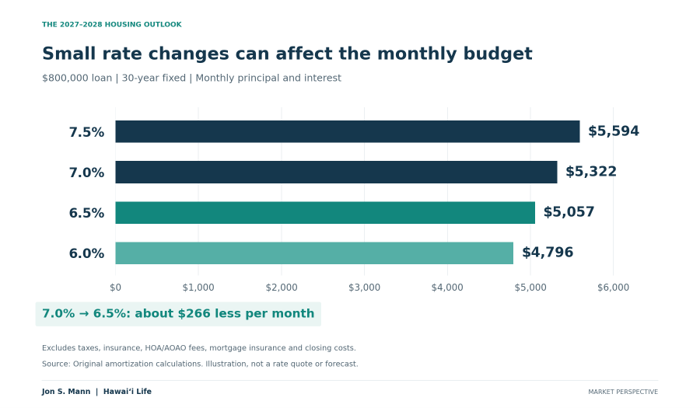
Chart 2. Original payment illustration for the same $800,000 loan over 30 years. Rates are examples, not quotes or forecasts. Payments exclude taxes, insurance, HOA/AOAO fees, mortgage insurance, and closing costs.
In this illustration, moving from 7.0% to 6.5% reduces principal and interest by approximately $266 per month. A smaller loan balance, a different property, or a negotiated financing concession may also change the budget. Each option should be evaluated with a lender, including any upfront cost and the length of time the buyer expects to own the home.
My advice is to make the purchase work at the rate and full payment available when you commit. A future refinance can be an opportunity if rates, equity, credit, and loan eligibility allow it. It should not be necessary to keep the home affordable.
My Outlook for 2027 is Gradual Improvement in Activity
Fannie Mae’s September 2026 forecast offers a useful example of recovery with elevated financing costs. Its Economic and Strategic Research group projected U.S. existing-home sales rising from 4.062 million in 2026 to 4.215 million in 2027, an increase of 3.8%. The same forecast assumed average 30-year mortgage rates of 6.5% in 2026 and 6.7% in 2027. September 2026
That model allows sales to improve without a return to pandemic mortgage rates. Its rate assumptions were set on August 31, before the October increase, so the forecast should be read with its date attached. It can change as conditions change. September 2026
My working expectation for 2027 is that more transactions can come together as households reassess their needs and buyers and sellers adjust to the cost of moving. A job change, a growing household, or the desire to downsize can eventually outweigh the appeal of keeping an existing mortgage.
The most encouraging version of that recovery would combine additional choices for buyers with prices sellers can realistically achieve. Sellers who are also buying could benefit from having more replacement properties to consider. Agents could spend more time solving the practical problems that stand between a client and a completed move.
I would expect that progress to vary by neighborhood and property type. Employment needs to remain reasonably steady, and buyers still need sufficient income and savings. This is a conditional expectation of more workable transactions, not a prediction that every listing will attract competing offers.
My Outlook for 2028 is a More Workable Market
There is also a published outlook extending through 2028. The Q3 2026 Home Price Expectations Survey, produced by Pulsenomics with Fannie Mae, reported average expert forecasts of 2.5% national home-price growth in 2026, 2.2% in 2027, and 2.7% in 2028.
The benchmark is the Fannie Mae Home Price Index, which covers single-family properties and excludes condominiums. Fannie Mae
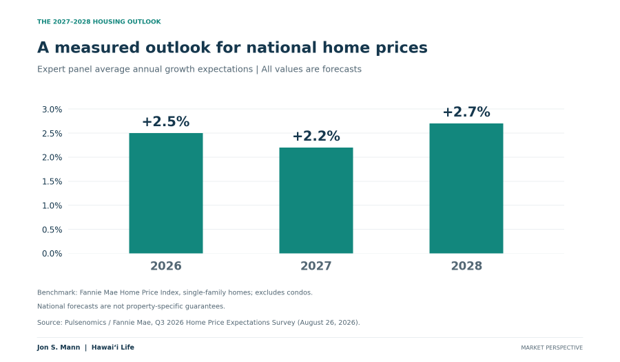
Chart 3. Expert panel expectations published August 26, 2026. These national forecasts do not predict a particular Oʻahu neighborhood, building, or property.
Forecasters differ. Fannie Mae’s own September research forecast put 2027 price growth at a more restrained 1.0% on a fourth-quarter-to-fourth-quarter basis. The expert survey and Fannie Mae’s internal forecast are separate outlooks. Their differences are a reminder to plan for a range of outcomes. September 2026
For me, the constructive possibility is modest price growth alongside gradually improving buying power. If household incomes grow faster than the combined cost of purchasing and maintaining a home, affordability can improve while owners retain much of their equity. More people may then be able to move for ordinary life reasons.
Hawaiʻi has some support for that view. UHERO’s September 25, 2026 outlook projected statewide real economic growth of 1.6% in both 2027 and 2028, following 0.6% in 2026. It also projected real personal income growth of 2.1% and 1.8% in those two future years. These are forecasts, including the 2026 estimate. uhero.hawaii.edu
UHERO anticipated annual average 30-year mortgage rates of about 6.7% in 2027 and 6.6% in 2028. Its outlook assumes some easing of energy-related pressures and progress in storm recovery. This is a case for gradual improvement that remains compatible with borrowing costs well above pandemic lows. UHERO
The farther ahead we look, the less useful a precise prediction becomes. My expectation for 2028 is a market in which more households can evaluate a move with workable numbers and more confidence. Stronger income, additional suitable housing, and steadier financing costs would help make that possible.
On Oʻahu the property and its competition matter
The Honolulu Board of REALTORS® reported that single-family homes sold in August 2026 spent a median of 17 days on the market, compared with 37 days for condominiums. A year earlier, those figures were 22 and 48 days.
Both categories moved faster among the properties that sold, while their different marketing times called for different expectations. Hawaii Real Estate Market Reports
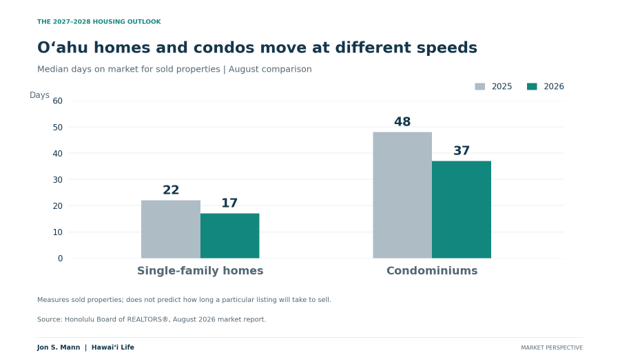
Chart 4. August resale data from the Honolulu Board of REALTORS®. These medians describe sold properties and do not predict the marketing time of an individual listing.
A Hawaiʻi Kai townhome should be evaluated against comparable townhomes and their total ownership costs. A Waikīkī leasehold condo requires a different analysis, including lease rent, remaining term, and financing. A detached house in Kailua will have its own set of competing properties and buyers.
For a condominium, I want the buyer and seller to understand the association’s finances, insurance, reserves, planned work, and any assessment exposure. A favorable national forecast cannot answer those building-specific questions. Reviewing them early gives everyone a better basis for discussing value and a smoother path through a transaction.
What Buyers Can Do With This Outlook
For buyers, the opportunity is to use the choices available now to make a deliberate decision. Look closely at comparable sales, inspect the property, understand the documents, and negotiate from a realistic assessment of the seller’s alternatives.
Start with a full monthly budget. Include principal and interest, taxes, insurance, association charges, maintenance, and any lease rent. Keep sufficient cash for closing and a reserve for ownership. A home that uses every available dollar leaves little flexibility when an expense changes.
Then compare the purchase with your actual alternative, including the rent you would pay and the time you expect to remain in the home. Waiting can be sensible when it strengthens your finances. Buying can be sensible when the property fits your needs, the payment is sustainable, and the ownership horizon gives you room to absorb market fluctuations.
If rates decline later, other buyers may regain purchasing power too. Sellers may also become more willing to list. The effect on prices will depend on which side of that supply-and-demand balance changes more. There is no single future rate that guarantees a better purchase.
What Sellers Can Do With This Outlook
For sellers, a measured outlook supports preparation and realistic pricing. Your home has to make sense beside the other properties a qualified buyer can choose. Presentation, condition, and clear information help buyers evaluate that choice.
Before listing, address the uncertainties most likely to affect confidence or financing. Depending on the property, that may mean documenting repairs, obtaining relevant inspections, assembling condominium information, or explaining a leasehold interest. Set the price using current competition and recent comparable sales, then pay attention to showing activity and substantive buyer feedback.
When you are selling and buying, look at the complete move. A concession on the sale side may be manageable if you negotiate favorable terms on the replacement property. Compare net proceeds, the new payment, timing, and the cost of holding either property. That analysis is more useful than measuring success only against a past market peak.
What This Means for Real Estate Agents
As a Broker-in-Charge, I see meaningful opportunity for agents who can make a complicated decision easier to understand. Clients benefit from a clear explanation of local inventory, an honest assessment of price, and early coordination with lenders and other professionals.
The work is specific. Know which properties are attracting offers. Understand why a condominium may be difficult to finance. Help a seller evaluate the cost of waiting. Show a buyer how two similarly priced homes can produce very different monthly expenses.
That kind of guidance remains valuable at any interest rate. An improving market could bring more transactions; the opportunity today is to help people become ready for the decisions they will eventually make.
A Confident Decision Begins With the Right Numbers
My optimism for 2027 and 2028 rests on the possibility of a better balance: more suitable homes, buyers with sustainable budgets, and sellers with achievable expectations. We can make useful progress before mortgage rates feel inexpensive again.
I will be watching employment and income, new listings, contract activity, and the full cost of ownership. Persistently higher rates, weaker hiring, or rising insurance and association expenses would make me more cautious. Better affordability and healthy local demand would strengthen the case for improvement.
The goal is to make a sound decision for your circumstances. Supply and demand set the conditions; careful planning helps you work within them.
If you are considering buying or selling on Oʻahu, I would welcome a conversation about your neighborhood, your likely monthly costs, and the steps that would put you in a stronger position. Whether your timeline is this year, 2027, or 2028, we can begin with a practical plan.
Jon S. Mann, REALTOR®
Broker-in-Charge, Hawaiʻi Life Real Estate Brokers
East Oʻahu
Market observations and forecasts reflect information reviewed as of October 7, 2026. Forecasts are conditional and subject to revision. National statistics and price indexes do not determine the value or future performance of an individual property. All real estate is local and national statistics are simply points of reference.
Sources
- National Association of REALTORS®: August 2026 Existing-Home Sales Report, released September 10, 2026.
- Freddie Mac: Primary Mortgage Market Survey, October 1, 2026; and Housing Supply: Still Undersupplied by Millions of Units, November 26, 2024, using data through Q3 2024.
- Federal Reserve Bank of St. Louis: What Determines Mortgage Rates?, October 1, 2026.
- Fannie Mae Economic and Strategic Research: September 2026 Housing Forecast, dated September 11, 2026; interest-rate assumptions as of August 31.
- Pulsenomics and Fannie Mae: Q3 2026 Home Price Expectations Survey, published August 26, 2026. See also the Fannie Mae Home Price Index definition.
- UHERO: September 2026 State Forecast and Forecast Summary Table, September 25, 2026.
- Honolulu Board of REALTORS®: August 2026 Oʻahu Market Report.
- Mortgage-payment chart: Original calculations using an $800,000 loan, 360 monthly payments, and the illustrated fixed interest rates.

Leave your opinion here. Please be nice. Your Email address will be kept private, this form is secure and we never spam you.