Buying or Selling a Hawaii Vacation Rental in 2026? New Airbnb and Vrbo Rules Can Cost Tens of Thousands at Closing
If you own a vacation rental anywhere in Hawaii and are thinking about selling, or you are shopping for one, read this before you touch a calendar or sign a contract, please.

The Airbnb and Vrbo rules covered below are newer, they keep changing, and most owners only find out how they work when the cancellation bill arrives. Everything about Airbnb, Vrbo and the Hawaii purchase contract applies statewide, from Waikiki to Poipu to Kona. The Bill 9 section is Maui only.
Here is the rule that surprises almost every Hawaii vacation rental owner I talk to: when your property sells, your Airbnb listing, your reviews and your Airbnb reservations do not go with it.
The buyer is buying the real estate. The listing, the five star history and every confirmed guest start out tied to the seller’s host account. Airbnb keeps them there. Vrbo has a transfer process, which I cover below, but nothing moves automatically.
The Maui Seller Who Left the Calendar Open
I see this play out every month. A seller lists a Kaanapali or Kihei condo, leaves the calendar wide open and gets a strong offer. Then they realize a dozen or more confirmed reservations run past the closing date. Some are Christmas week. Some are families who booked a year ago.
At that point, every option costs money. The only question is how much, and who pays it.
Why I Know These Rules From Every Side of the Table
I have worked on this problem from every side of the table. Over my career, I have represented dozens of vacation rental buyers and sellers across Maui. On the industry side, I serve as President of the Board of HIMAST (the Hawai’i Mid and Short Term Rental Alliance). My past roles include President of the Board of the Maui Vacation Rental Association. Megan and I also ran a vacation rental program of over 40 properties with a cumulative value of of $150M+ plus for 12 years, and currently own and operate a vacation rental in Wailea, so the cancellation policies below are rules I live under too.
This post covers the current Airbnb and Vrbo rules, with real numbers. It also covers what sellers need to do the day they decide to list, and what buyers need to ask before they sign.
What Is in This Article
- Why Airbnb and Vrbo Listings Do Not Transfer With a Maui Property
- What It Costs to Cancel a Maui Guest Because You Sold
- Vrbo’s Property Sale Rules for Maui Hosts
- Airbnb’s Rules When a Maui Host Sells
- The Stranded Guest Problem in Peak Maui Season
- Why It All Comes Down to the Net for Maui Buyers and Sellers
- Four Strategies for Selling a Maui Vacation Rental With Bookings
- A Calendar Timeline for Maui Sellers, From Listing Day to Closing
- What Maui Buyers Should Demand Under Section N-2 of the Hawaii Purchase Contract
- Should You Buy a Maui Vacation Rental With Bookings Attached?
- Selling or Buying a Minatoya List Condo Under Bill 9
- Licenses, Taxes and the Fresh Start a Maui Buyer Inherits
- Thinking About Selling or Buying a Maui Vacation Rental?
- Frequently Asked Questions About Selling a Maui Vacation Rental With Bookings
Why Airbnb and Vrbo Listings Do Not Transfer With a Maui Property
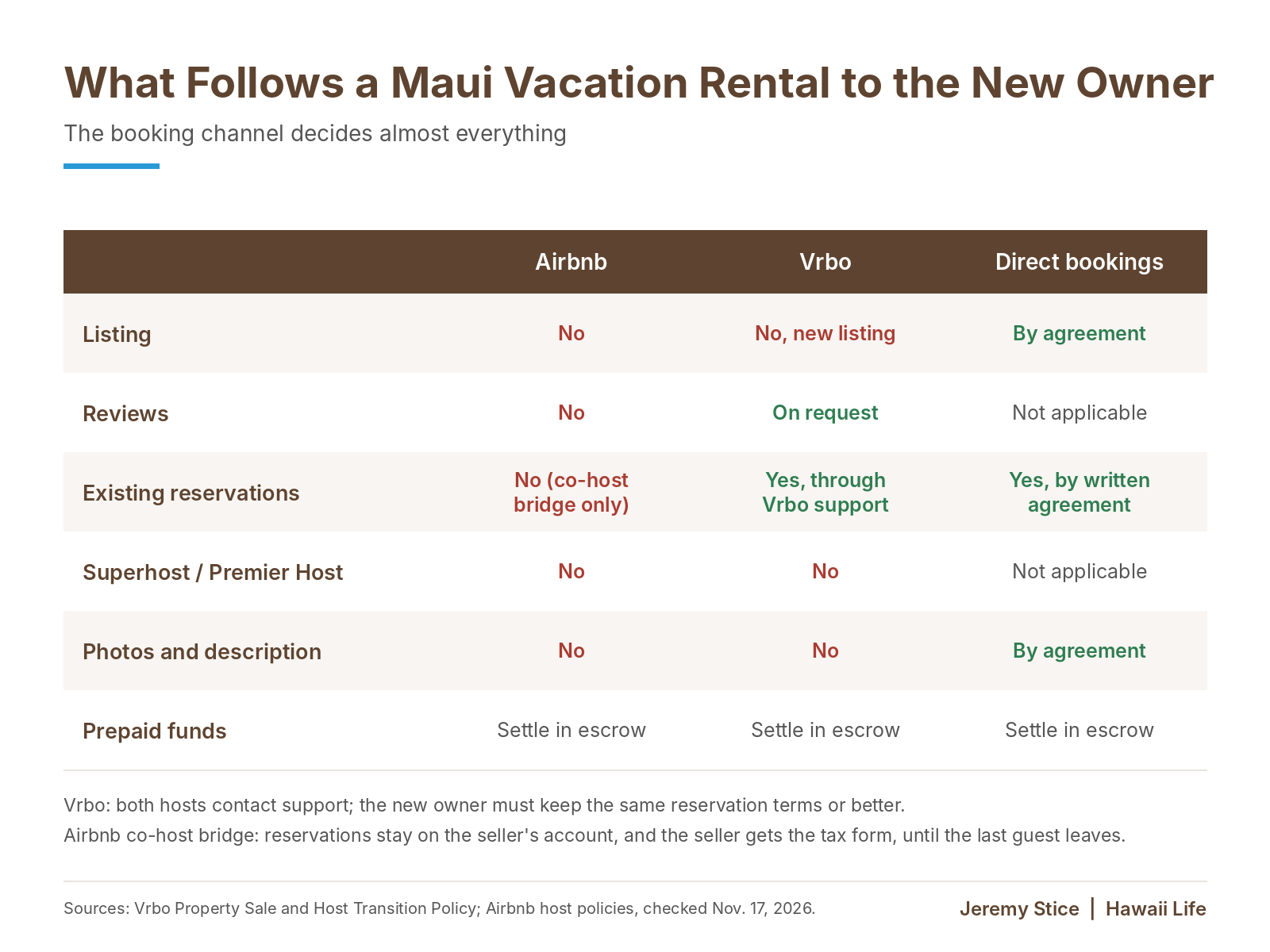
Airbnb and Vrbo are built around the host, the person or company that holds the account. Reviews, Superhost or Premier Host status, payout history and guest relationships all sit on that account.
So when a Napili condo sells, the platforms see a host who is leaving and a new host who is starting over. The buyer starts a brand new listing under their own host account, with zero reviews.
There are a few important differences between the platforms, which I break down below. Vrbo now has a formal process for moving reservations to a new owner. Airbnb does not let you transfer a listing at all.
These Airbnb and Vrbo Rules Are New and Keep Changing
These are newer rules, and they are constantly changing. What I wrote about Vrbo in 2022 is no longer true today. The fee tiers, the waiver rules and the transfer process have all shifted in the last few years, and the platforms update them without much notice.
So treat every figure in this post as a snapshot from November 2026. Before you list, or before you write an offer, pull the current policy from each platform your property is on. I do this on every deal, because the version a seller remembers from their last sale is often out of date.
That fresh start also means a longer ramp up. A new listing on a new account has no reviews, no Superhost or Premier Host status and no booking history for the search rankings to reward. In my experience, as the platforms keep changing their rules for new hosts and new listings, the time it takes a new listing to get fully optimized has been getting longer. That is a real cost, and buyers and sellers should both be pricing it in.
If you take one thing from this post: decide your calendar strategy the day you sign your listing agreement. By the time an offer arrives, it is too late. Your calendar is booking months ahead whether you are paying attention or not.
What It Costs to Cancel a Maui Guest Because You Sold
Both platforms charge hosts a fee for canceling a confirmed reservation. Each has a short list of reasons it may waive that fee, and selling your property is not on either list. Vrbo goes further and excludes sale related cancellations in writing, as you will see below. Budget for the fee. Do not plan around an exception.
Airbnb and Vrbo Host Cancellation Fees in 2026
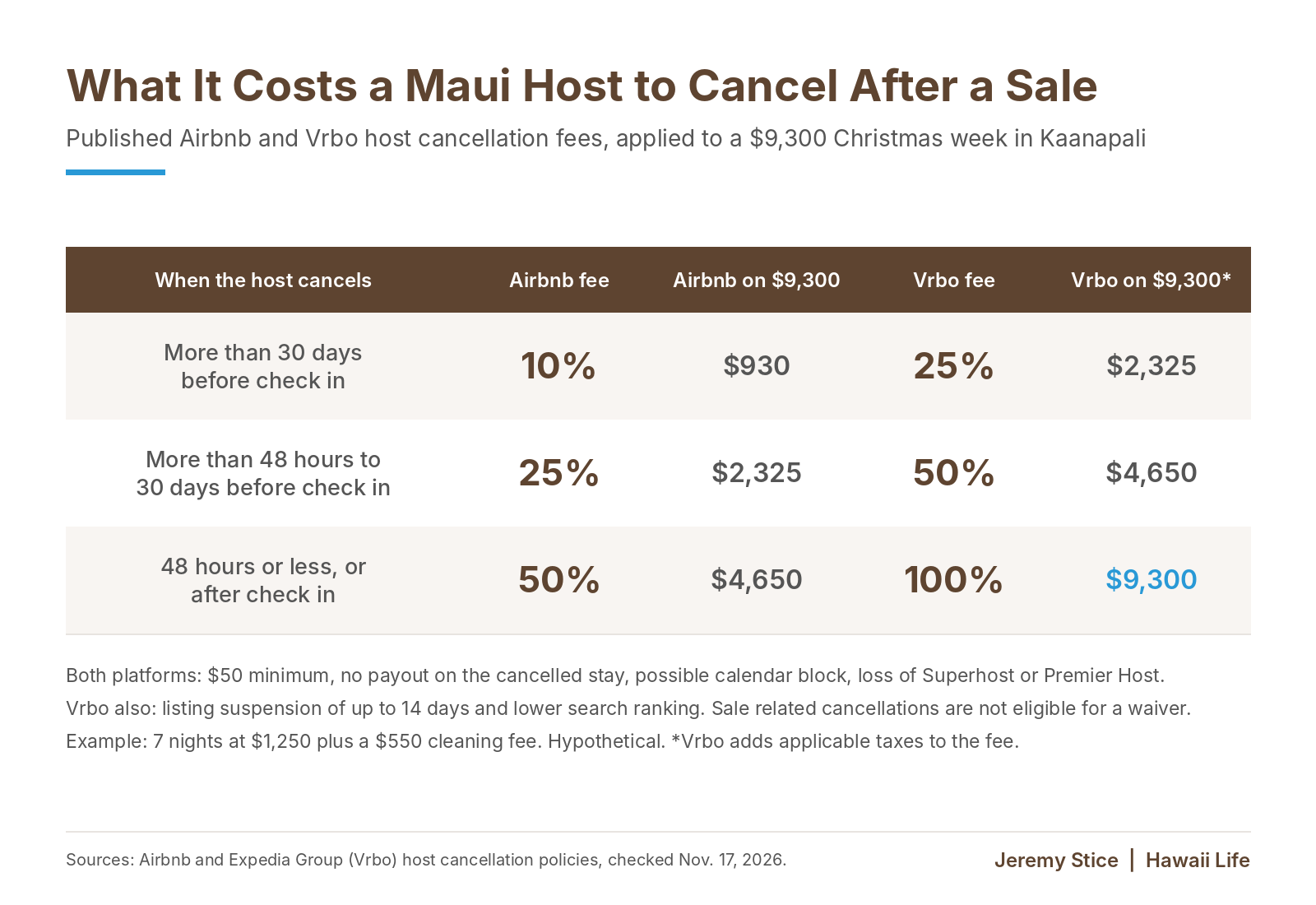
Here are the published host cancellation fees as of November 2026:
Airbnb (percentage of the reservation amount, which includes the nightly rate, cleaning fee and pet fees, but not taxes or guest fees, with a $50 minimum):
- More than 30 days before check in: 10%
- More than 48 hours and up to 30 days before check in: 25%
- 48 hours or less before check in, or after check in: 50% (after check in, it is 50% of the nights not stayed)
Airbnb calculates the fee differently for stays of 28 nights or longer, based on the non refundable portion of the booking at the time you cancel.
Vrbo (percentage of the reservation amount, including the nightly rate and mandatory fees like cleaning, with applicable taxes added on top of the fee and a $50 minimum):
- More than 30 days before check in: 25%
- More than 48 hours and up to 30 days before check in: 50%
- Within 48 hours of check in, or after check in: 100%
And the fee is only part of it. On both platforms you also lose the payout on the cancelled booking. If it already paid out, it comes back out of future payouts. The dates can be blocked so you cannot rebook them, and you can lose Superhost or Premier Host status. Vrbo can also suspend the listing for up to 14 days and drop its search ranking.
The Math on One Kaanapali Christmas Week
Let me put real numbers on that. Say a Kaanapali condo has a Christmas week booking at $1,250 a night for seven nights, plus a $550 cleaning fee. That is a $9,300 reservation before taxes.
- Airbnb, more than 30 days out: a $930 fee
- Inside 30 days but more than 48 hours, on Airbnb: a $2,325 fee
- Within 48 hours on Airbnb: a $4,650 fee
- Vrbo, more than 30 days out: about $2,325, plus taxes on the fee
- Inside 30 days but more than 48 hours, on Vrbo: about $4,650, plus taxes on the fee
- Within 48 hours on Vrbo: about $9,300, plus taxes on the fee
That is the penalty on one booking. On top of it, you give up the income that stay would have earned you after cleaning and other costs. Now multiply it across a full holiday calendar, which a Maui condo listed in the fall can easily be carrying.
What a Full Maui Winter Season Can Cost
Here is what that looks like across a season. Say a seller accepts an offer in October with a December closing, and has ten week long stays booked from Christmas through February, averaging $9,300 each. Canceling all ten more than 30 days out costs about $9,300 in Airbnb fees, or about $23,250 on Vrbo plus taxes. Any stay that has slipped inside 30 days costs more than double. And that is before the roughly $93,000 in rent those stays would have brought in, less the cleaning and operating costs you would no longer have.
For a high end Maui home, the numbers get much bigger. Take a luxury home renting at $5,000 a night with a $1,000 cleaning fee, so $36,000 a week. The same ten week winter season is $360,000 in bookings. Canceling it more than 30 days out costs about $36,000 in Airbnb fees, or about $90,000 on Vrbo plus taxes. On top of that, the seller gives up hundreds of thousands of dollars in rent.
Vrbo’s Property Sale Rules for Maui Hosts
Vrbo is the platform that has thought hardest about this, and it has a written Property Sale and Host Transition Policy. If your Maui vacation rental is listed on Vrbo, these are the rules you are agreeing to:
- Notify affected guests promptly, including whether the new owner will honor their reservation
- Offer those guests a full refund if they want to cancel, and the host has to initiate the cancellation rather than asking the guest to do it
- Only accept new bookings that end before the expected sale date, and tell those guests the property is for sale
- Block the calendar for dates after the expected sale date
- Remove the listing after the sale
Here is the line most sellers miss. Vrbo says cancellations caused by a sale are not eligible for a waiver. That holds even if the guest is the one who cancels after being told about the sale. Those cancellations fall under the host cancellation fees above.
Moving Vrbo Reservations to the New Owner
Now the good news, and it is a real change from when I wrote about this in 2022. Vrbo now has a process for moving reservations to the new owner’s listing. Both hosts contact Vrbo support together, the new owner creates their own listing, and the new owner has to keep the same reservation terms or better. Guests still get the choice to keep the booking or take a refund, so do not count a transferred booking as the buyer’s income until Vrbo confirms the move. Reviews may be transferred on request, though Vrbo does not guarantee it. Photos and descriptions cannot.
The two hosts also have to agree on how the payout money gets divided, and Vrbo says it will not mediate that. That is a contract issue, and it belongs in your purchase contract in writing before you close.
Airbnb’s Rules When a Maui Host Sells
Airbnb does not allow a listing to be transferred from one host account to another. Reviews and Superhost status stay with the seller.
Airbnb’s list of valid reasons to cancel without fees covers things like major property damage, emergency repairs, serious illness and declared emergencies. Selling your property is not on that list. I have heard plenty of owners say you can get the fees waived by sending Airbnb your closing documents. I would not count on it, and I would never build a sale timeline around it.
The Airbnb Co-Host Bridge and Its Tradeoffs
The common workaround is a co-host bridge. Before closing, the seller adds the buyer (or the buyer’s manager) as a co-host. The existing guests stay put, and the new owner builds their own listing for future dates.
It works, and I have seen it work. But be clear eyed about the tradeoffs:
- The seller stays on the hook. The reservations still live on the seller’s account and under the seller’s name until the last guest checks out
- Payouts and taxes get messy. Airbnb lets the listing owner share payouts with a co-host, but according to Airbnb’s co-host payout rules, the listing owner still receives the tax document on the full booking amount. Buyer and seller need a written agreement on how rent, taxes, fees and refunds get handled. Sellers, talk to your CPA before you agree to a co-host arrangement, because that tax form can leave you reporting income on guests whose rent went to the buyer
- Reviews land on the seller. If the new owner has a rough first month, the seller’s review history takes the hit
For a seller who is selling because they are done hosting, that is a lot of lingering exposure. Use the co-host bridge for a short window, with a written agreement that covers payouts, taxes, insurance, guest claims and a hard end date, or not at all.
The Stranded Guest Problem in Peak Maui Season
There is a human side to this, and it can be gut-wrenching at times.
A family that booked a Wailea condo for Christmas and New Year’s 11 months ago has flights, a rental car and kids who have been counting down. If that booking gets canceled three weeks out, they are shopping during the most expensive stretch of the year on Maui. Replacements usually cost far more than they booked.
The holidays are the peak, but they are not the only expensive window. February is close behind, with whale season and Presidents’ Day week, and spring break is up there too. A last minute cancellation in any of those weeks leaves a guest with very few good options.
A confirmed reservation is a commitment to the guest under the booking terms. Canceling it because you sold can create real legal exposure, on top of the platform fees. I am not an attorney, and if you are facing this, talk to one. But I have seen enough angry guests to know that “the property sold” does not land well with someone standing at the Kahului airport.
In my experience, guests who get plenty of notice, a full refund option and a real alternative are almost always understanding. The disasters I have seen started with last minute cancellations.
Why It All Comes Down to the Net for Maui Buyers and Sellers
Here is the part most people miss. None of these costs stay with just one side. In my experience, every one of them ends up as a line item in a net figure for both the buyer and the seller.
For the seller, that number is net proceeds at closing. Cancellation fees, refunded rent, a later closing date to let bookings run out and the management company’s fee on stays it booked all come out of it.
For the buyer, that number is the true cost of the property and its first year of income. Below market bookings they agree to honor, the ramp up on a new listing, deposits and prorations, and the cost of starting over on Airbnb all count against it.
So the real negotiation is rarely just price. It is price, credits, the closing date and who honors which bookings, all solved together. A seller facing roughly $23,250 in Vrbo fees on a winter season may come out well ahead offering a modest credit to a buyer who agrees to honor those stays. The buyer collects the rent, the guests keep their vacations, and both nets improve.
That is why I run the numbers for both sides before we write an offer or respond to one. When the buyer and seller each see their own net, deals that look stuck usually get solved.
Four Strategies for Selling a Maui Vacation Rental With Bookings
Every seller has to pick one of these. Here is how I think about each, including where each one hurts.

1. Let the Bookings Run Out, Then Close
You keep accepting bookings up to a hard stop, and you set the closing date after the last guest checks out.
- Pros: the safest route, with no cancellations, no fees, full rental income through closing and a clean handoff
- Cons: it limits your buyer pool to people willing to wait, and it can stretch a 30 day cash escrow into a 90 day one
2. Set a Rolling Calendar Cutoff
The day you list, you restrict future availability to a window that fits a realistic sale. On Maui, vacation rental listings commonly take three to four months to sell, plus a 30 to 75 day escrow. So I usually start with about four to six months out and adjust as the listing goes. On Vrbo, the window is tighter, because new stays have to end before your expected sale date.
- Pros: you keep income flowing and keep a verifiable rent roll for buyers, without stacking up bookings you cannot honor
- Cons: you give up some far out peak season bookings, and you have to actually manage the window every few weeks
3. Sell With the Bookings Transferring to the Buyer
The buyer agrees in the purchase contract to honor reservations, with deposits and rents settled through escrow.
- Pros: the buyer gets income on day one, the guests are protected, and the bookings become a selling feature
- Cons: it only works cleanly for Vrbo and direct bookings, and Airbnb requires the co-host bridge. It also takes a buyer who wants a rental and an agent on each side who knows how to paper it
4. Wind Down With Cancellations
You cancel the bookings past closing and eat the fees.
- Pros: the fastest, cleanest path to an empty property for a buyer who wants a second home or a long term rental
- Cons: the most expensive option, with fees, lost income, lost status and the stranded guest risk above
Here is my contrarian take for sellers: do not block your whole calendar the day you list. A booked peak season at real rates, on a property you can show a buyer line by line, is the best proof of income you have. The goal is a calendar you can honor, and blocking everything gives that up for nothing.
A Calendar Timeline for Maui Sellers, From Listing Day to Closing
Here is the sequence I walk sellers through:
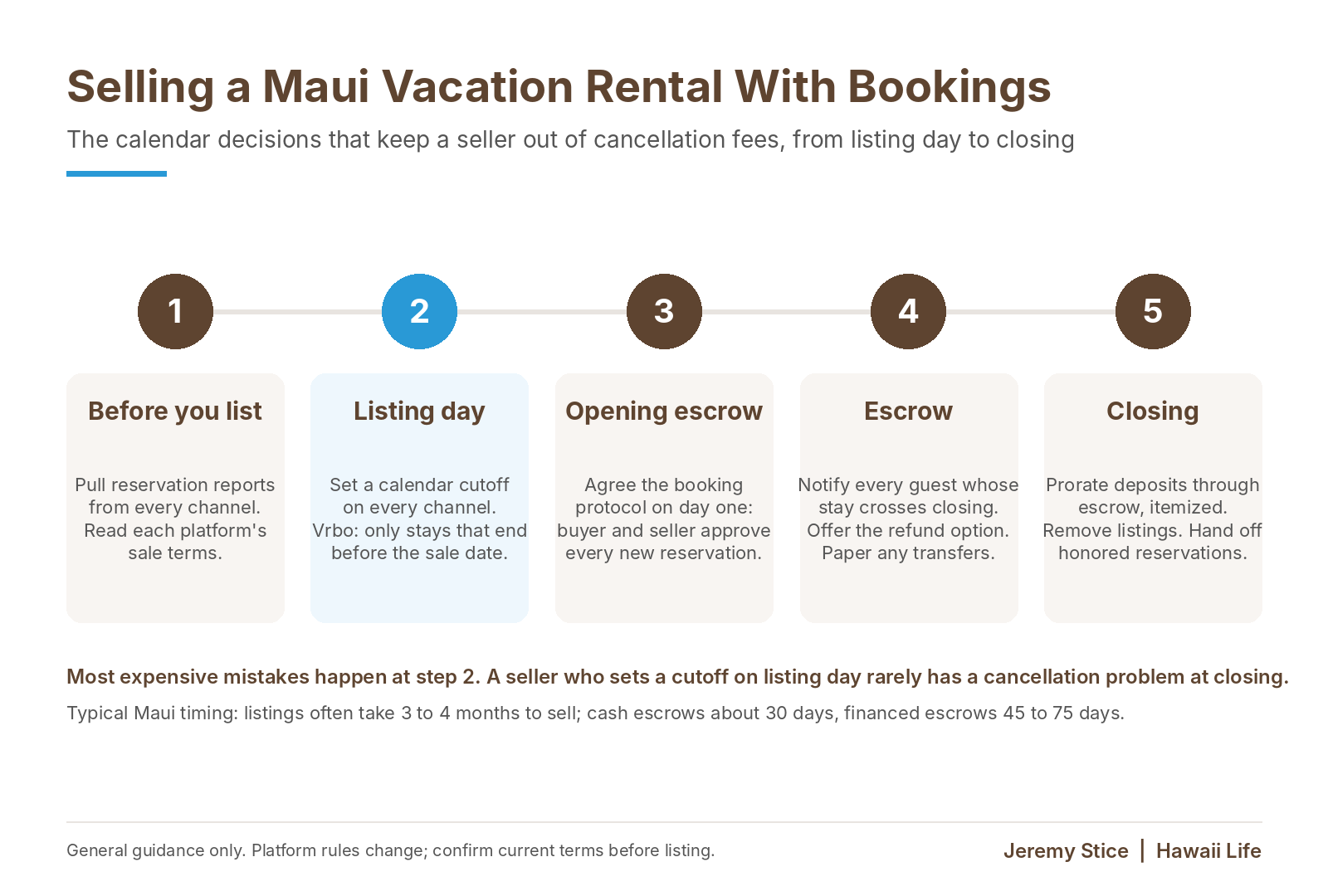
- Before you list. Pull a full reservation report from every channel: Airbnb, Vrbo, Booking.com, Marriott Bonvoy Homes & Villas, Expedia and direct. Each one has its own terms, so read each before you decide anything.
- Listing day. Set your calendar cutoff on every channel. On Vrbo, from here on you can only take bookings that end before your expected sale date. New guests also need to be told the property is for sale.
- Opening escrow. The standard Hawaii purchase contract already bars the seller from taking any new vacation rental reservation that runs past closing without the buyer’s prior written consent (Paragraph N-3). I go one step further and require that every new reservation after acceptance be approved in writing by both buyer and seller. Do not wait for the first booking request to figure out how that works. Agree on the protocol in writing the day escrow opens. Cover who approves, how fast each side responds, a minimum rate, which channels are allowed, and whether a stay can run past closing. Deliver the reservation list to the buyer during the review period.
- Escrow. Cash deals on Maui often close in about 30 days and financed deals in 45 to 75. Notify every guest whose stay crosses the closing date, tell them what is happening, and offer the refund option the platform requires.
- Closing. Settle prepaid rents and deposits through escrow with an itemized breakdown. Remove or deactivate the listings. Give the buyer the arrival details for any reservation they agreed to honor, within what each platform allows you to share.
Where Maui Sellers Usually Go Wrong
What Maui Buyers Should Demand Under Section N-2 of the Hawaii Purchase Contract
Now the buyer’s side.
Section N of the current Hawaii Association of Realtors purchase contract (revised 2/25) gives you two choices on rentals. Under N-1, the seller delivers the property vacant at closing, free of tenants, leases, property management contracts and short term rental reservations. Under N-2, the seller delivers the rental documents within a set number of days after acceptance. Those include any vacation rental reservations and the property management contract. You then get a set number of days to review them and terminate if you do not accept what you see. Vacation rental deposits transfer to the buyer at closing under N-2.
Paragraph N-3: The Escrow Booking Rule Most Maui Owners Miss
Then there is N-3, which applies either way and which most owners have never read. During escrow, the seller cannot enter into any new vacation rental reservation that extends beyond the closing date without the buyer’s prior written consent. A seller who keeps taking bookings past closing after an accepted offer is out of compliance with the contract they signed. I wrote about the mechanics in detail in Part 1 and Part 2 of my series on transitioning a Hawaii vacation rental during a purchase. Keep in mind I wrote those posts years ago, in 2022. The contract mechanics still hold up, but the Airbnb and Vrbo rules have changed since then, so where they differ, go by this post.
My N-2 Checklist for Maui Vacation Rental Buyers
If you are taking reservations under N-2, here is what I ask for on every deal:
- Every reservation, by channel. Airbnb, Vrbo, Booking.com, direct. The channel decides whether the booking can move to you at all
- The rate on each stay. Below market friends and family rates, or a holiday week booked a year ago at last year’s pricing, are now your problem
- Owner blocks and unpaid stays. Dates blocked for the seller’s personal use or comped stays are not income
Deposits, Management Contracts and Written Terms
- Deposits and prepaid funds, itemized. Nightly rate, taxes collected and fees, plus who is holding each dollar: the platform, the manager, the seller or escrow. Then document the credits at closing. I have received a lump sum with no breakdown before. Do not accept that
- The current management agreement. Many give the outgoing company its full fee on reservations it booked, even after you take over. Know what you owe before you close
- A booking protocol for escrow, agreed when escrow opens. N-3 covers new reservations that run past closing. I make every new reservation after acceptance subject to both parties’ written approval. That includes stays that end before closing, because they still affect the rent roll and the guest experience. Write down how requests get sent, who approves, the response time and the rate floor. That way a good booking is not lost waiting on an answer, and a bad one does not slip through
- A written special term on transfers. The standard N-2 language covers delivering documents and transferring deposits. It does not address moving bookings between Airbnb or Vrbo accounts, review transfers or guest contact information. Write it in
And put every material promise in a written contract amendment. I once had a seller agree verbally to transfer reviews, then refuse after closing. Nothing on paper meant nothing to enforce.
Should You Buy a Maui Vacation Rental With Bookings Attached?
Not always. Here is the honest version.
Reasons to take the bookings:
- Income from day one. A new listing starts with zero reviews, and a ramp up period at lower occupancy or lower rates is normal. In my experience, that ramp up period has been getting longer as the platforms change their rules, and transferable bookings help carry you through it
- Proof of demand. Real bookings at real rates tell you more than any pro forma
- Guest goodwill. Honoring them keeps the property’s reputation intact with the people most likely to return
Reasons to choose N-1 and start clean:
- You plan to use it yourself, rent it long term, or renovate right after closing
- The bookings are underpriced and locked in at rates you would never accept
- You are leaving a front desk rental program. Some resort programs rent by unit category, and depending on the program’s terms, guests can be moved to other units. The guest you think you are inheriting may not be booked into your unit at all
- The channel mix is mostly Airbnb, and the co-host bridge would tie you to the seller’s account longer than you want
My bias: if the rates are fair and most of the bookings are Vrbo or direct, take them. If the calendar is mostly Airbnb at stale rates, negotiate N-1 or a price that reflects the cost of the transition.
Either way, the bookings are evidence, and nobody is guaranteeing them. Paragraph R-2 of the purchase contract says the seller and the brokerages make no guarantees about future rents, and a buyer who rents the property after closing assumes those risks. Underwrite accordingly.
Selling or Buying a Minatoya List Condo Under Bill 9
On Maui, this conversation now has another layer.
Bill 9, now Ordinance 5909, phases out most vacation rental use in apartment zoned condos, the so called Minatoya list, with some specific exceptions. The current deadlines are January 1, 2029 in West Maui and January 1, 2031 in the rest of the county, most of which is South Maui. Lawsuits have been filed challenging it. The County has also created new hotel zoning districts. But each complex still has to apply and be approved, so the path alone does not protect any one building.
Zoning is the first thing to check. Some condos that operate as vacation rentals are hotel zoned and sit outside Bill 9 entirely, which I covered in my full list of hotel zoned condo vacation rentals on Maui. Others carry different zoning altogether. Before you buy, confirm the zoning and the legal basis for vacation rental use on that specific building with County records. A listing description is not enough.
For sellers on that list, it raises the stakes on calendar discipline. Buyers are already pricing in the phase out. Open bookings that run near or past those dates will draw hard questions.
For buyers, any reservation, rent projection or management promise on a Minatoya list property needs to be read against those deadlines. If a building is pursuing hotel zoning, ask where that stands and get it in writing.
Licenses, Taxes and the Fresh Start a Maui Buyer Inherits
Very little of the seller’s rental setup comes with the property. As the new operator, plan on:
- Your own Hawaii General Excise Tax and Transient Accommodations Tax registrations. The seller’s numbers do not transfer, and Hawaii requires the operator’s TAT registration number in every advertisement, including your new Airbnb and Vrbo listings
- Today’s tax stack. The state TAT rose from 10.25% to 11% on January 1, 2026, on top of Maui County’s 3% TAT and the general excise tax. Price your rates accordingly
- New listings, new photos, new reviews. Vrbo reviews may transfer on request. Airbnb reviews will not
- A ramp up period in your numbers. Budget for lower occupancy and lower rates while the new listing builds reviews and ranking. If your underwriting assumes the seller’s revenue from your first month, it is too optimistic
- A management decision before closing. Self manage, use the resort’s front desk program, or hire an independent manager, and have it signed before escrow closes so there is no gap
The buyers who do best line all of this up during the review period, so the property is ready to take guests the week they close.
Thinking About Selling or Buying a Maui Vacation Rental?
These rules are new, they keep changing, and most owners only learn them when they get the bill.
If you are even considering selling a Maui vacation rental in the next year, talk to me before you touch your calendar or sign a listing agreement please. We will pull your reservation reports, pick a strategy that fits your timeline, and price the property so your bookings help the sale.
If you are buying, I will read the rent roll line by line and sort out which reservations can actually move to you. Then I write the transfer terms into your contract, so nothing depends on a handshake.
Call or text me at 808.281.2178 or email JeremyStice@HawaiiLife.com.
Frequently Asked Questions About Selling a Maui Vacation Rental With Bookings
Can I transfer my Airbnb listing to the buyer when I sell my Maui vacation rental?
No. Airbnb does not allow a listing, its reviews or Superhost status to be transferred to another host account. The buyer creates a new listing under their own host account. Some sellers add the buyer as a co-host before closing so existing guests can stay, but the reservations remain on the seller’s account until those stays are complete.
Can Vrbo reservations be transferred to a new owner?
Often, yes, under Vrbo’s Property Sale and Host Transition Policy. The new owner creates their own listing, both hosts contact Vrbo support to move the reservations, and the new owner must keep the same reservation terms or better. Each guest can still choose a refund instead. Reviews may be transferred on request, but photos and descriptions cannot.
Does Airbnb or Vrbo waive cancellation fees when a property sells?
Vrbo states that cancellations caused by a property sale are not eligible for a waiver, even when the guest cancels after being told about the sale. Airbnb’s list of valid reasons to cancel without fees does not include selling the property.
How much does it cost a host to cancel an Airbnb or Vrbo reservation?
As of November 2026, Airbnb charges 10% of the reservation amount if the host cancels more than 30 days before check in, 25% from more than 48 hours up to 30 days, and 50% within 48 hours, with a $50 minimum. Airbnb calculates fees differently for stays of 28 nights or longer and for cancellations after check in. Vrbo charges 25%, 50% and 100% for the same timeframes, with a $50 minimum plus applicable taxes on the fee. Hosts also lose the payout and can lose Superhost or Premier Host status.
Should I block my calendar when I list my Maui vacation rental for sale?
Most sellers should restrict it and keep a limited window open. Set a cutoff that fits a realistic sale and escrow timeline, often about four to six months out on Maui, and adjust it as the listing progresses. If the property is on Vrbo, only accept new bookings that end before the expected sale date.
Can a seller take new vacation rental bookings during escrow on Maui?
Not for stays that run past closing without the buyer’s consent. Paragraph N-3 of the Hawaii Association of Realtors purchase contract bars the seller from entering into new vacation rental reservations that extend beyond the closing date without the buyer’s prior written consent. Many agents, including me, go further and have both parties approve every new reservation in writing. The best practice is to agree on that approval process when escrow opens, including who approves, how quickly each side responds, a minimum rate and whether a stay can run past closing.
Are the Airbnb and Vrbo rules for selling a property changing?
Yes. These policies are relatively new and the platforms update them often. Vrbo’s current reservation transfer process, for example, differs from the guidance I described in my 2022 posts. Check each platform’s current policy before listing a property or writing an offer.
What is Section N-2 in the Hawaii purchase contract?
N-2 is one of two rental options in Section N of the Hawaii Association of Realtors purchase contract. The seller delivers the rental documents, including vacation rental reservations and any property management contract, within an agreed number of days after acceptance, and the buyer has an agreed number of days to review them and terminate if not acceptable. Vacation rental deposits transfer to the buyer at closing. Under N-1, the property is delivered vacant, free of tenants, management contracts and short term rental reservations.
Mahalo,
Jeremy

Leave your opinion here. Please be nice. Your Email address will be kept private, this form is secure and we never spam you.