Bill 9 After 11 Months: Who Actually Bought Maui’s Minatoya Condos
Eleven months after Bill 9 became law, Maui Minatoya condos have gone through a substantial repricing. However, relatively few of those purchases have turned into homeownership for Maui residents.
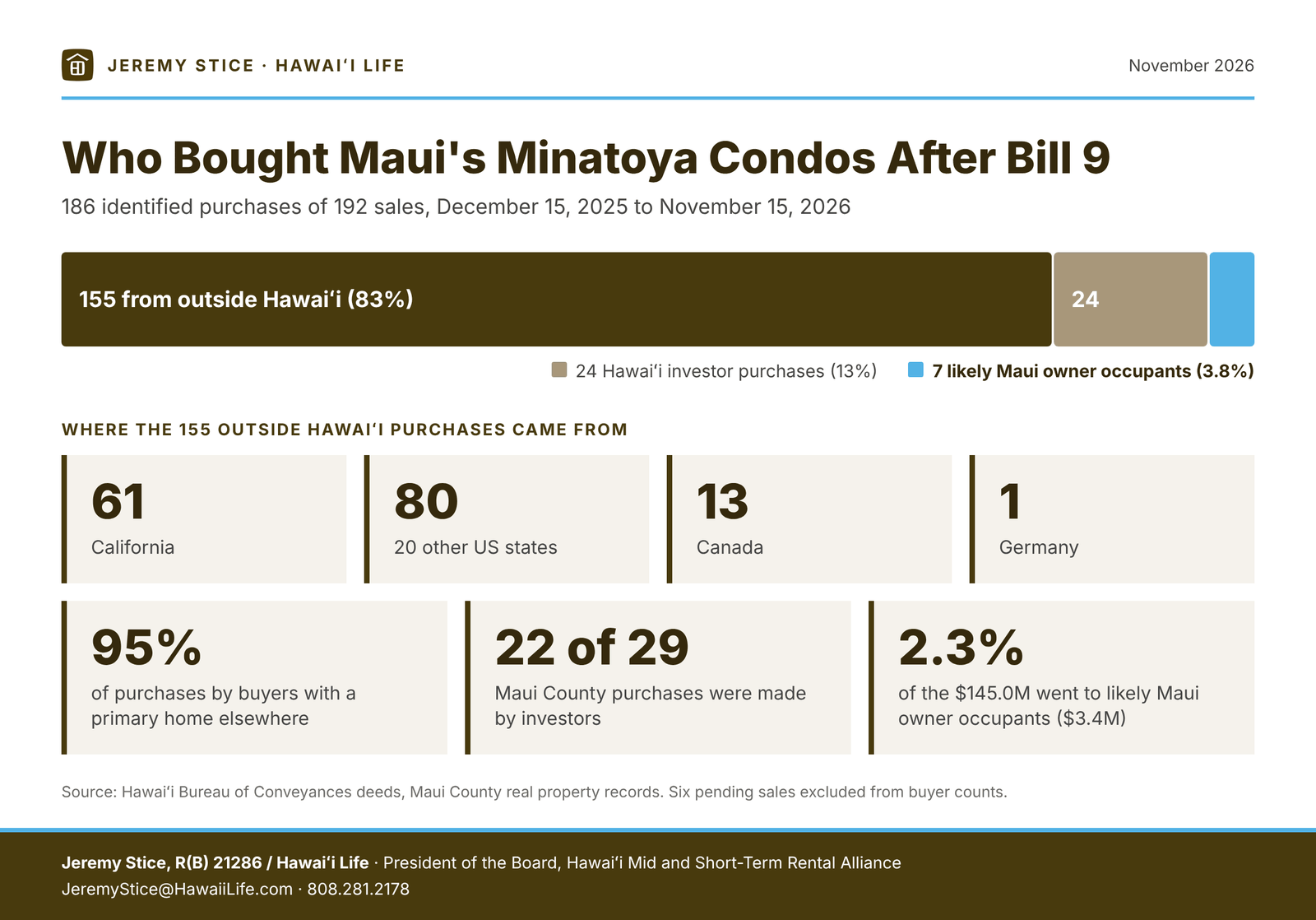
Of the 192 recorded sales, buyers could be identified in 186. Seven were classified as likely Maui owner occupant purchases, about 3.8% of the identified purchases. Those numbers come from a deed by deed review of every sale on the County’s Minatoya list from December 15, 2025 to November 15, 2026. Each buyer was traced through Bureau of Conveyances deeds, County property records and the state business registry.
The full housing impact of Bill 9 cannot be known before its phase out deadlines. For now, these early sales measure who bought the Maui Minatoya condos that sold. That is a narrower question than the bill’s whole effect on housing, but it is an important one.
This is the first in a series of posts on what the Bill 9 sales are telling us. This one answers the basic question: who is actually buying these condos?
Where I Sit on Bill 9
I was born and raised here on Maui, and I care deeply about our local housing supply. I am a strong advocate for affordable housing. Some of the most rewarding deals of my career have been helping the people I grew up with buy their first homes.
At the same time, I am not neutral on Bill 9. My work is selling Maui vacation rental condos. I also serve as President of the Board of HIMAST (the Hawaii Mid and Short Term Rental Alliance). Megan and I own and operate a vacation rental at Hoolei in Wailea.
That is exactly why I want you to see the deeds instead of my opinion. Check every number below against the sources at the bottom please.
The research was compiled by a reputable colleague I have collaborated with, and is shared here with permission. The analysis of what it means for Maui owners and buyers is mine.
What Is in This Article
- Who Bought Maui’s Minatoya Condos in the First 11 Months of Bill 9
- Bill 9’s Stated Goals, Checked Against the Maui Deeds
- Where Maui’s Minatoya Buyers Live
- Minatoya Prices Against Maui County’s Affordability Benchmarks
- Limited Upward Pricing Pressure in Maui’s Minatoya Market
- The Seven Likely Maui Owner Occupant Purchases
- The Fair Objection: Maui’s 2029 and 2031 Deadlines Have Not Hit Yet
- Why Maui’s Master Planned Resorts Present Different Housing Economics
- Where the Minatoya Discount Went on Maui
- How I Help Maui Minatoya Owners and Buyers Through Bill 9
- How This Maui Deed Data Was Built and Its Limits
- Frequently Asked Questions About Who Is Buying Maui Minatoya Condos
Who Bought Maui’s Minatoya Condos in the First 11 Months of Bill 9
Bill 9 passed the Maui County Council 5 to 3 on December 15, 2025. Mayor Bissen signed it the same day. It is now Ordinance 5909. Qualifying Minatoya vacation rentals may generally keep operating through December 31, 2028 in West Maui. Elsewhere in Maui County, the date is December 31, 2030. Both are subject to applicable legal and operational requirements.
The First 11 Months of Maui Minatoya Condos Under Bill 9
Here is what happened in the first 11 months:
- 192 Minatoya condos sold for $145.0 million, at a median of $607,500
- 155 of 186 identified purchases (83%) were attributed to buyers outside Hawaii. In fact, California alone accounted for 61, more than twice as many as all of Maui County
- 176 purchases (95%) were classified as investor or second home acquisitions by buyers with a primary home somewhere else. Even among Maui County purchases, 22 of 29 were investor purchases
- Only 7 purchases (3.8%) were classified as likely Maui owner occupant purchases. Together they came to $3.4 million, 2.3% of the money that changed hands
- 182 of 192 condos sold at or below asking, and sellers gave up $10.4 million off their list prices
- Prices fell drastically for Maui Minatoya condos. In 13 complexes I tracked in the MLS, the median sale price fell about 35%, or roughly $370,000. It went from $1,055,000 in December 2022 to November 2023 to $685,000 in December 2025 to November 2026
However, six sales had not reached the public deed index by November 17, 2026. They count in the price figures and stay out of every buyer count, which is why buyer figures use 186. Counts are purchases: a few buyers bought more than one condo.
The Realtors Association of Maui Found a Similar Pattern
This is not the only count. In an October 14, 2026 op ed in Maui Now, the Realtors Association of Maui reviewed 183 condo sales recorded from January through July 2026. Nearly 70% had tax bill mailing addresses in the continental US. Also, about 34% had no mortgage recorded, which suggests all cash purchases.
RAM’s analysis and the deed research both point to substantial buying by people from outside Hawaii. Still, their percentages are not directly comparable. The two studies cover different sales and periods, and they classify buyers differently. In addition, a mailing address alone cannot establish residency.
Bill 9’s Stated Goals, Checked Against the Maui Deeds
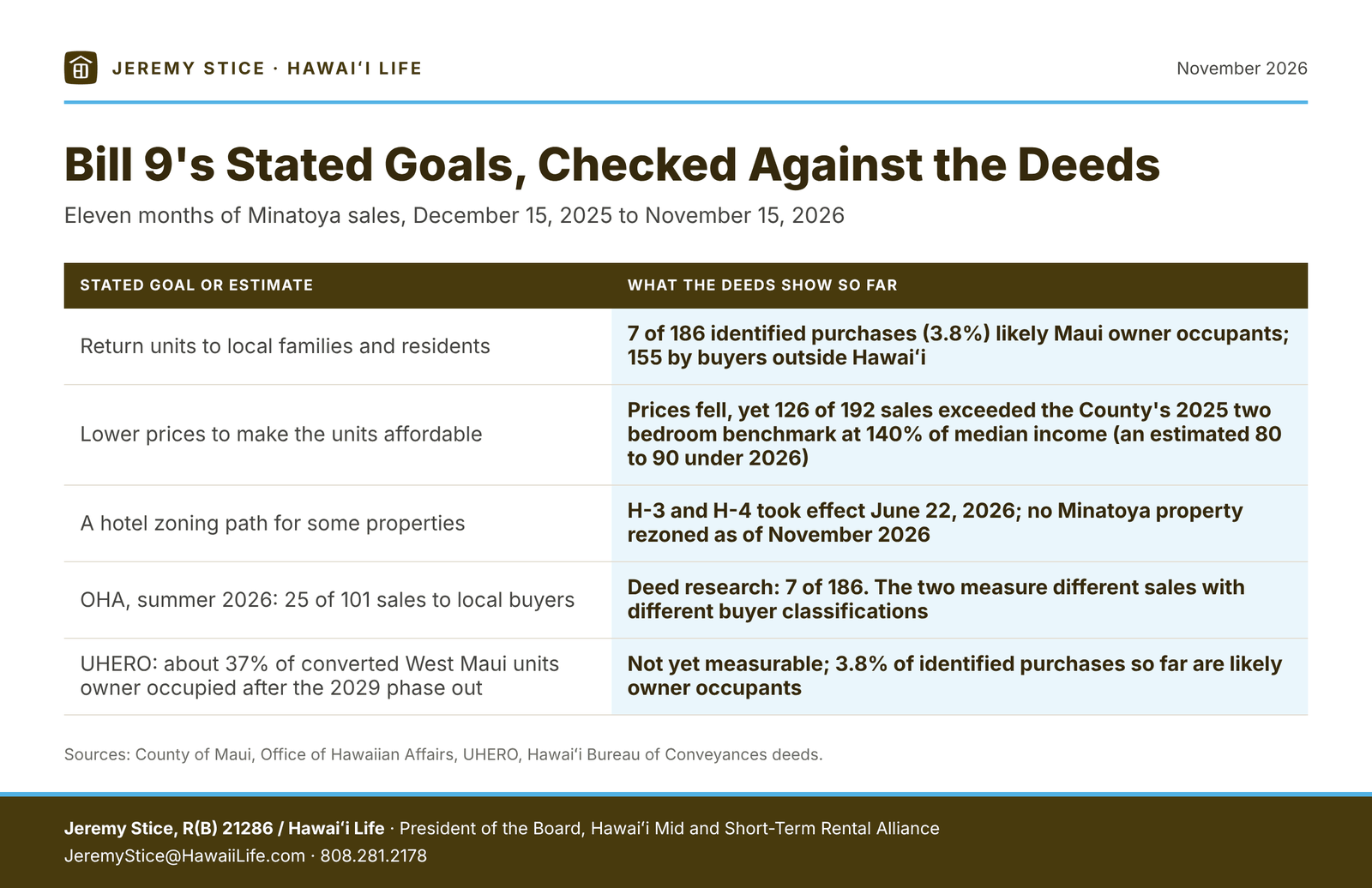
When Mayor Bissen signed the bill, he described the principle guiding it from the beginning. It was to “return apartment-zoned housing to local families and residents.”
How Maui Minatoya Condos Compare With the Goals of Bill 9
Eleven months of recorded deeds let us measure where things stand against the bill’s stated goals. Here is how they line up so far:
- Return units to local families and residents. 7 of 186 identified purchases (3.8%) were likely Maui owner occupant purchases. 155 were attributed to buyers outside Hawaii
- Lower prices to make the units affordable. Prices did fall. Even so, 126 of 192 sales exceeded the County’s 2025 two bedroom benchmark at 140% of median income. Against the higher 2026 benchmarks, I estimate roughly 80 to 90 still did. The median 2 bedroom sold for $836,000
- A hotel zoning path for some properties. The new H-3 and H-4 hotel districts took effect June 22, 2026. As of November 2026, no Minatoya property has been rezoned into them
OHA and UHERO Figures Against the Maui Deeds
- Local buyers in the early sales. The Office of Hawaiian Affairs cited 25 of 101 sales going to local buyers in summer 2026. By contrast, the deed research counts 7 of 186. OHA’s figure and this research measure different groups of sales using different buyer classifications. This analysis applies a narrower definition, counting only purchases identified as likely primary residences for Maui residents
- Owner occupancy after the phase out. UHERO’s March 2025 analysis estimated that about 37% of converted West Maui units would become owner occupied. That estimate applies once vacation rentals end there in 2029. That conversion, however, has not happened yet. Among the first 11 months of identified purchases countywide, 3.8% were likely owner occupant purchases
Where Maui’s Minatoya Buyers Live
Five in six identified purchases were made by buyers from outside Hawaii. Most of the Hawaii purchases were investor purchases too.
- 155 of 186 identified purchases were attributed to buyers outside Hawaii: 141 from 21 other US states, 13 from Canada and one from Germany
- The West Coast accounted for 83 purchases, 45% of the total. California alone had 61
- Of the 31 Hawaii purchases, 24 were investor purchases by buyers who already own a home in the islands. Two of those purchases were by buyers on Oahu and Hawaii Island
- Maui County’s 29 purchases were made by 26 buyers, and three Maui investors bought two units each
A Hawaii buyer and a local family housed are two different things. Any headline that counts Hawaii buyers will count those 24 investor purchases as local wins.
Maui Investors Already Own a Lot of Hawaii Property
For 51 of the investor purchasers, the records show other Hawaii property as well. Between them, they own at least 146 Hawaii properties, counting what they bought here. That is a floor, because holdings were found by name search. Anything held under another name or LLC can be missed.
Who These Buyers Are at Home
For 141 purchases, an estimated value for the home at the buyer’s mailing address could be found. The median estimate is $1,288,100, broadly comparable to the $1,150,000 median Maui single family home sale in September 2026. These estimates come from automated valuations and tax assessments, so they give general context only. Therefore, they cannot establish household wealth, age or liquidity.
My own recent transactions, however, paint a clearer picture. I am meeting buyers who are prepared to carry a Maui second home without vacation rental income. I cover what that may mean for the deadlines further down.
Minatoya Prices Against Maui County’s Affordability Benchmarks
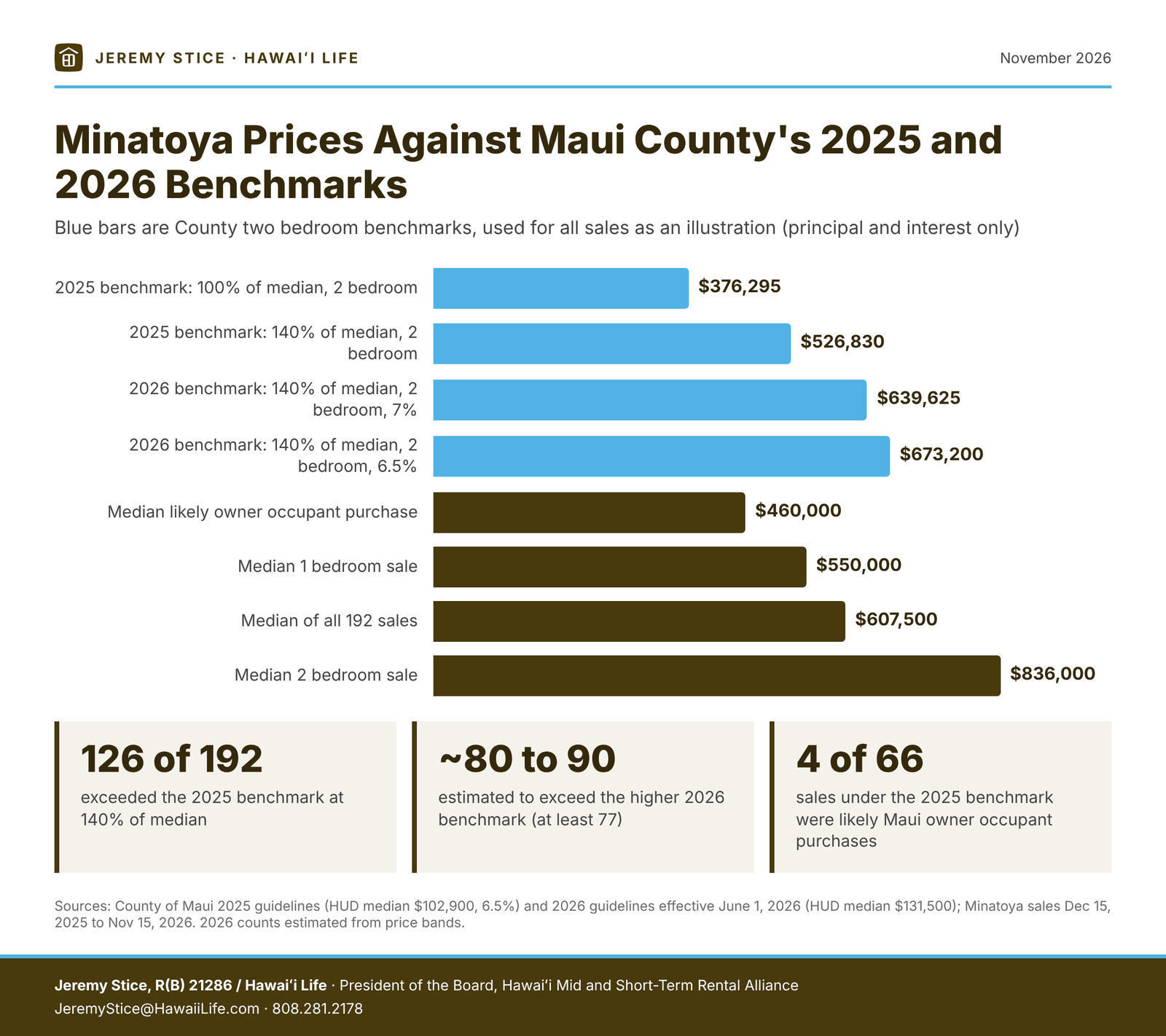
For consistency, this analysis uses the County’s 2025 affordable sales price guidelines. They were in effect when Bill 9 became law. They use a HUD median family income of $102,900 and a 6.5% mortgage rate. Here are the two bedroom benchmarks:
- 100% of median income: $376,295
- 140% of median income: $526,830
The County has since published 2026 guidelines, effective June 1, 2026, using a higher HUD median family income of $131,500. At a 6.5% rate, the 2026 two bedroom benchmarks are $480,845 at 100% of median and $673,200 at 140%. At 7%, they are $456,875 and $639,625. As an illustration, I use the two bedroom benchmark across all sales, including 1 bedroom units. The results under both years follow below.
Mortgage Rates and the County Benchmarks
However, the 2025 benchmarks were set at a 6.5% rate. Conventional 30 year rates have been floating around 7% since. In fact, Freddie Mac’s weekly survey put the average at 7.28% on November 19, 2026. Every half point makes the same condo more expensive for a local buyer who needs a mortgage. A cash buyer, by contrast, does not feel it at all.
The County’s guidelines state that sales prices are calculated using principal and interest only. So those benchmarks should be read alongside the real monthly cost of owning a specific condo. That includes maintenance fees, property tax, insurance and any special assessments, which in these buildings can be heavy. One Papakea owner testified that dues, taxes and other costs on a 1 bedroom came to $3,521 a month. That was before any mortgage.
What the 192 Minatoya Sales Look Like Against Those Benchmarks
- 126 of 192 sales (66%) exceeded the 2025 two bedroom benchmark for households at 140% of median income. Of the 66 that did not, three in four were attributed to buyers outside Hawaii. Only 4 were likely Maui owner occupant purchases
- Under the 2026 benchmarks, an estimated 80 to 90 of 192 sales still exceeded the 140% level. That is about 42% to 46%, depending on whether you use a 6.5% or 7% rate. At least 77 (40%) sold for more than $700,000, above the 2026 benchmark at either rate. Even with more condos within reach on paper, few went to local buyers. Of the 115 sales at $700,000 or less, 6 were likely owner occupant purchases
- The median 2 bedroom sold for $836,000, and the median 1 bedroom for $550,000. Both are also above the 2025 140% benchmark
- Only one property with two or more bedrooms sold below $376,295, and it was leasehold
- Eight properties with two or more bedrooms sold below $526,830, and none were classified as Maui owner occupant purchases
- The four lowest priced sales were all attributed to buyers outside Hawaii
UHERO’s Earlier Read on Maui Minatoya Condos
UHERO reached the same conclusion before the vote. It appraised the median affected unit at $971,500, affordable to only the top 14% of Maui families. It also projected that even a 25% price fall would raise that share only to 21%.
What Monthly Dues Do to Maui County’s Affordability Math
The County’s benchmarks are calculated on principal and interest only. In these buildings, every owner also pays a monthly maintenance fee.
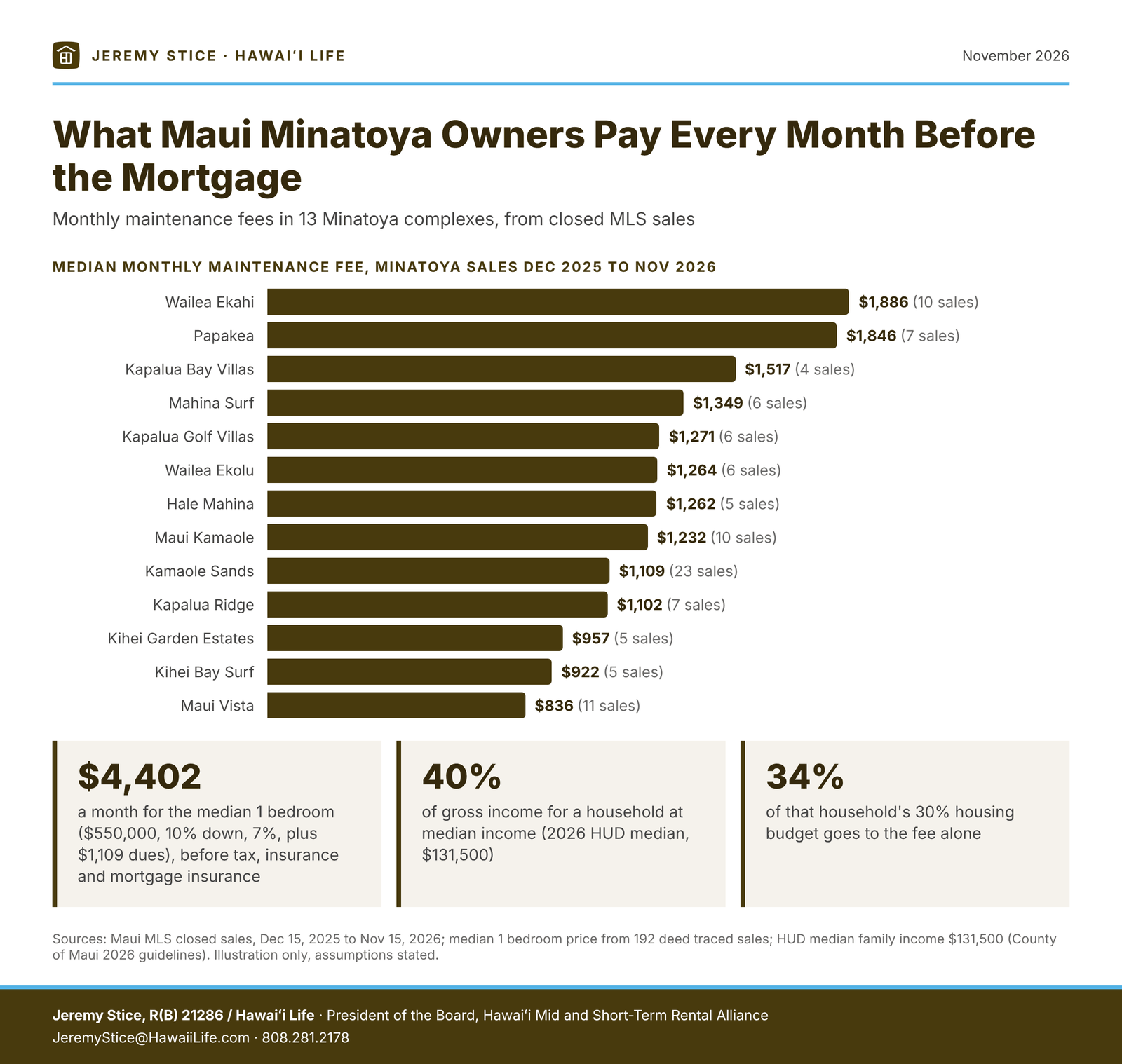
I also tracked fees in the MLS sales from my 13 Minatoya complexes over the last 11 months. The median maintenance fee was $1,109 a month on a 1 bedroom and $1,408 on a 2 bedroom. By complex, it ran from $836 at Maui Vista to $1,846 at Papakea and $1,886 at Wailea Ekahi.
Take the median 1 bedroom at $550,000, with 10% down at 7% on a 30 year loan:
- Principal and interest: about $3,293 a month
- Maintenance fee: about $1,109 a month
- Total: about $4,402 a month, before property tax, insurance, mortgage insurance and special assessments
Monthly Costs of Maui Minatoya Condos Against Household Income
How that compares with income depends on which HUD median you use:
- Using the 2025 median ($102,900): a household at 140% of median earns about $12,005 a month. So $4,402 is 37% of its gross income, above the commonly used 30% housing affordability benchmark
- Using the 2026 median ($131,500): a household at 140% of median earns about $15,342 a month. So the same payment is about 29%, right at the benchmark before property tax and insurance. However, a household at median income would spend about 40% of its gross income. The fee alone would take about a third of a 30% housing budget
The fees are rising too. The median fee per square foot in these complexes rose about 18% from late 2022 to late 2026. Meanwhile, prices fell. Hotel zoned buildings saw similar increases, so this is a Maui condo problem as much as a Bill 9 one. Still, it lands hardest on the local buyer the bill was written for.
Special Assessments in Maui Minatoya Buildings
Then come special assessments, the bills an association levies for big repairs on top of the monthly fee. The MLS data here is incomplete. For one, the special assessment field was completed for only 306 of the 858 sales. Also, listings with assessments may be more likely to disclose them. The amount field also mixes monthly payments and one time charges. As a result, these figures should not be read as the share of all sales with assessments. Even so, 20 of 52 answering Minatoya sales in the last 11 months reported a special assessment. That is up from 4 of 37 in late 2022 and 2023.
- Papakea: 18 of 22 answering sales reported an assessment, tied to plumbing infrastructure upgrades
- Mahina Surf: 6 of 6, with listings showing an amount of about $946
- Kamaole Sands: listings in 2024 disclosed assessment amounts of roughly $24,000 to $48,000 per unit, also for plumbing infrastructure upgrades
- Kapalua Ridge: assessments of roughly $5,600 to $9,000 per unit, reportedly driven by rising insurance premiums
Why Assessments Matter for Local Buyers
Unexpected assessments can be particularly hard on households that have already stretched to buy a home. Buyers with larger financial reserves may be better positioned to absorb them.
Limited Upward Pricing Pressure in Maui’s Minatoya Market
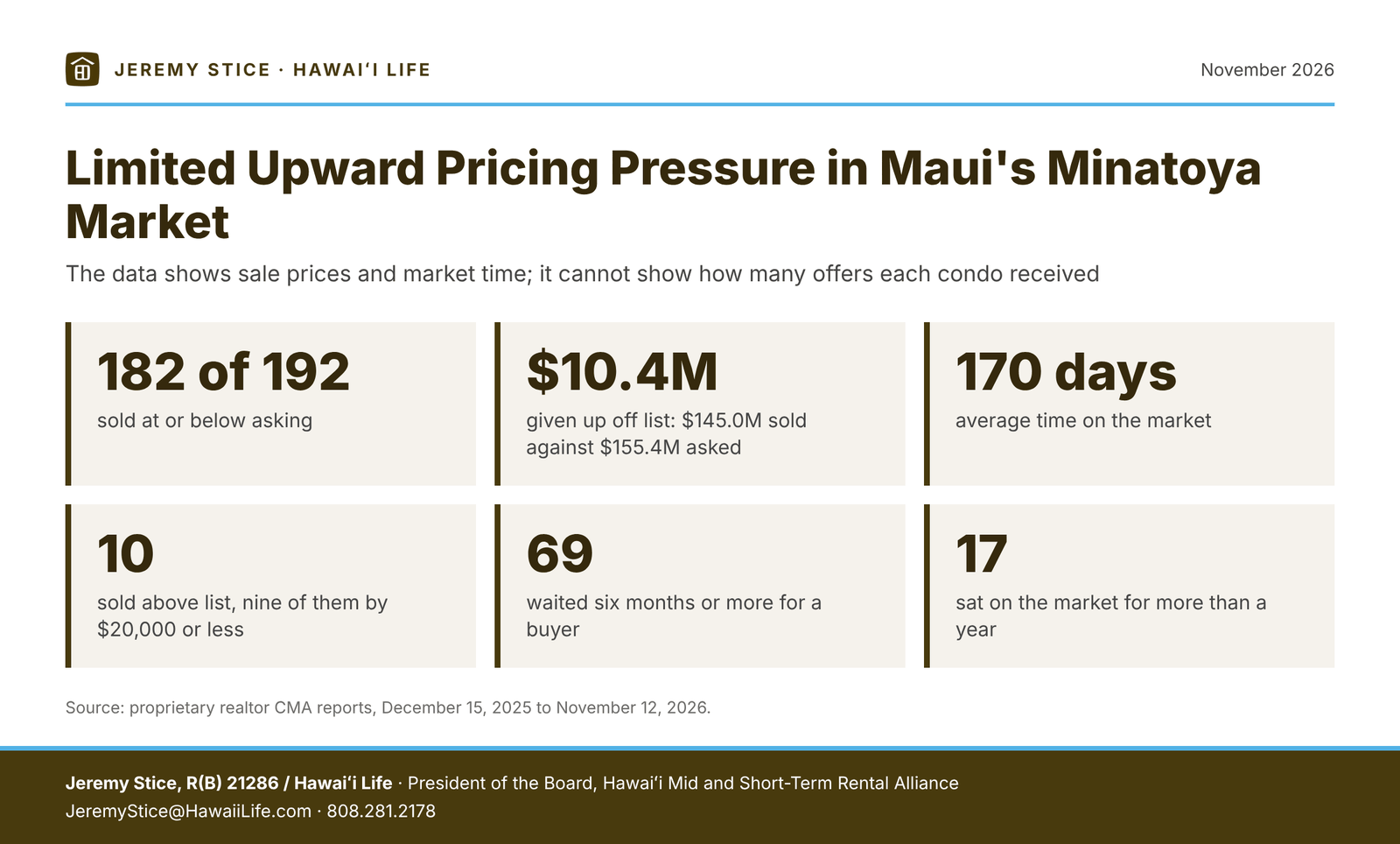
The recorded sales show little evidence of widespread upward pricing pressure.
- 182 of 192 condos sold at or below asking. Only 10 sold above list, and nine of those by $20,000 or less
- The 192 condos sold for $145.0 million against $155.4 million in asking prices. That means sellers gave up $10.4 million on prices that had already fallen
- The average condo sat on the market for 170 days. 69 waited six months or more, and 17 waited more than a year
The data cannot show how many offers each condo received or whether local buyers made offers that lost. It does suggest that affordability and suitability deserve close attention alongside buyer competition.
In my read, the bigger obstacle for local families is the cost of ownership. Even at these prices, many Maui Minatoya condos remain out of reach for local families. Others, meanwhile, are of little interest to them. For example, a 590 square foot 1 bedroom with resort level dues is a hard sell. A Maui family often needs three bedrooms and a yard for the kids.
The Seven Likely Maui Owner Occupant Purchases
Seven purchases were classified as likely Maui owner occupant purchases, with no other property found in state conveyance records. One of the seven is a possible case only.
The typical local purchase was a 1 bedroom of about 590 square feet, at a median of $460,000.
Previous Maui Homeownership Among the Seven
One potential benefit of lower prices for Maui Minatoya condos is more first time homeownership for Maui residents. So the early sales are a chance to see whether that is happening. Of the seven, three involved buyers with previous Maui homeownership. Four had no earlier Hawaii property ownership identified in the records reviewed. Even so, the records cannot establish how long those buyers had lived on Maui.
So 4 of the 192 sales, about 2%, involved Maui owner occupants with no previous Hawaii property found.
What About Mainland Buyers Who Moved Here?
Still, a few would argue that mainland buyers who sold up and moved to Maui should count as local. Four buyers fit that description. Each has a Maui mailing address now and a mainland address on the deed or in recent records.
Counting the three who live in their units raises the local share from 3.8% to 5.4%. Those three are the remaining identified purchases outside the 176 investor and 7 owner occupant purchases. They are counted among the 155 purchases attributed to buyers outside Hawaii. For Maui’s housing supply, however, one unit is absorbed and one new household is added.
In my view, conversions from vacation rentals to owner occupied homes also deserve a look at their fiscal impact. Depending on its tax class and past rental activity, a property could produce less property tax and transient accommodations tax. However, a full assessment would also need to account for public service costs and other economic activity.
The Fair Objection: Maui’s 2029 and 2031 Deadlines Have Not Hit Yet
Here is the strongest argument against reading too much into these 11 months. I want to take it head on.
Qualifying Minatoya vacation rentals may generally keep operating through December 31, 2028 in West Maui. Elsewhere, the date is December 31, 2030, subject to applicable legal and operational requirements. An investor buying today may get two to four years of rental income at a deep discount. Of course investors are buying now. Supporters of the bill will say the real test comes after the deadlines.
That is fair as far as it goes. Three considerations are worth examining:
- Nothing stops a local family from buying and moving in today. An owner occupant can live in a Minatoya condo right now. Prices fell, condos sat for 170 days, and 182 of 192 sold at or below asking. UHERO’s own premise was that falling prices would open the door to local buyers. That opportunity has been available for 11 months.
- The deadline will land on the investors who bought this year. They will make the call in 2029 and 2031: rent long term, sell, or hold. Whether Bill 9 delivers housing now depends on those investors.
- Many of these buyers are not counting on rental income at all. That changes what happens at the deadline, and it is the next section.
Many Maui Minatoya Buyers Are Underwriting Second Homes
“Investor” in this data means only that the buyer has a primary home somewhere else. In the transactions I am seeing, many buyers are underwriting Maui Minatoya condos as second homes. They have no need for rental income to carry the costs. Any rental income before the deadline is a bonus to them.
In my experience, that makes them more affluent than the Minatoya buyers we saw in years past. For decades, the typical buyer in these buildings needed vacation rental income to help cover the mortgage, dues and taxes. Today’s buyer can carry dues, property tax, insurance and special assessments out of pocket, often with no mortgage at all. RAM’s October review found that about 34% of the condo sales it looked at had no mortgage recorded.
Cash Share in Maui Minatoya Sales, 2022 to 2026
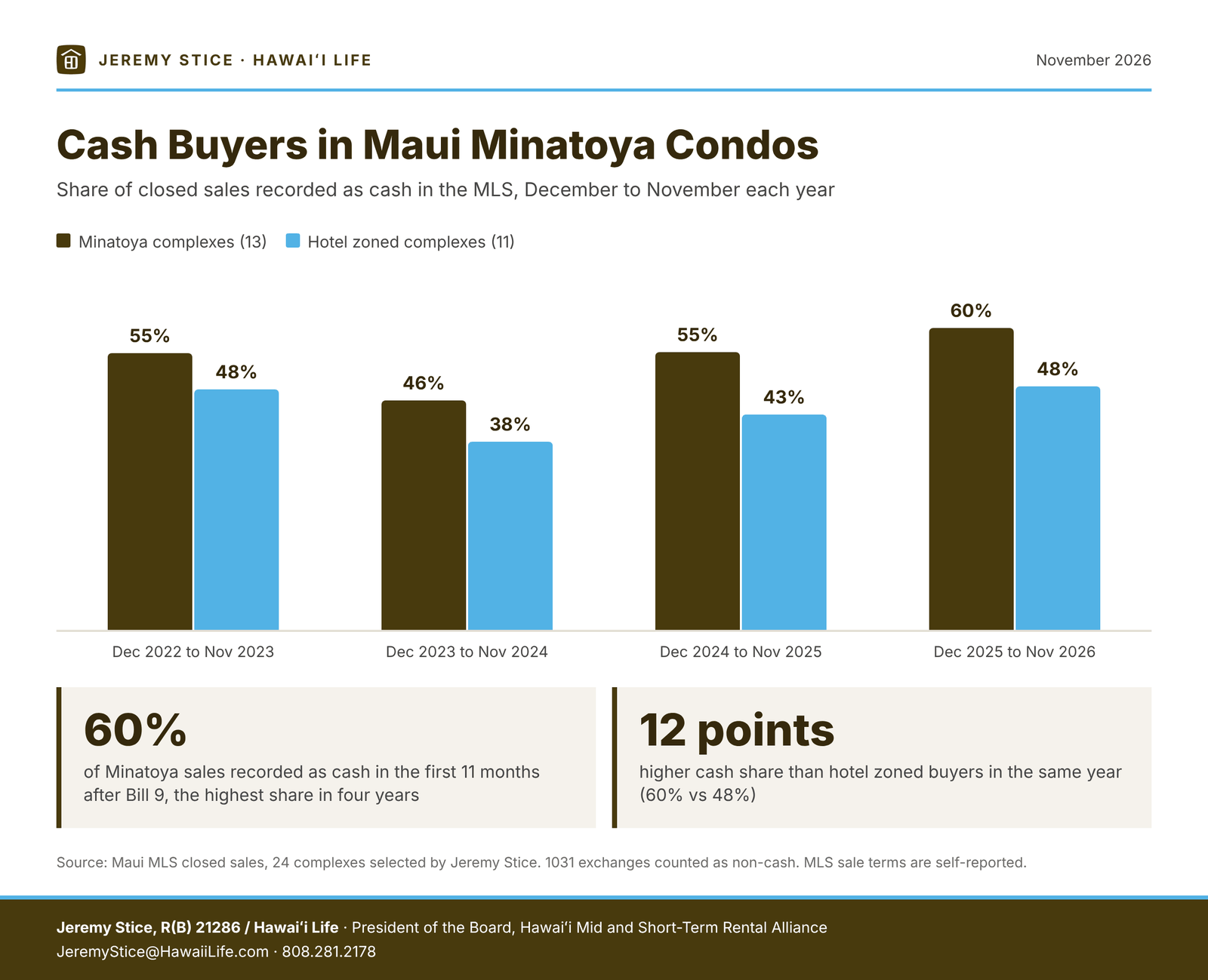
To test this, I pulled every closed MLS sale from January 2022 to November 2026. That covers 13 Minatoya complexes and 11 hotel zoned complexes. In Bill 9’s first 11 months, 60% of sales in these Maui Minatoya condos were recorded as cash. That is the highest share in four years, and 12 points above the hotel zoned buildings (48%).
The cash share in the Minatoya complexes ran 55% in the year before the phase out was announced. Then it dipped to 46% in the year it was announced, before climbing to 55% and now 60%. Over the full period, the cash share rose 5 points in the Minatoya complexes. In the hotel zoned ones, it rose less than 1 point. The rise is real but modest, and MLS sale terms are self reported. The analysis counts sales coded as cash. It counts 1031 exchanges, which can also close without financing, as non cash. I treat this as support for what I see in my own transactions, short of proof.
What the Second Home Shift Means for Maui Minatoya Condos
I and others in the vacation rental community have raised this with the County since Bill 9 was proposed. Take away the rental income, and you take away the buyer who needed it. What remains is the buyer who does not need it. That buyer was never going to rent long term to a Maui family.
My prediction, flagged as speculation: West Maui in 2029 will be the real test. For many of these owners, the deadline will not force a choice at all. A second home owner who never needed the rent can simply stop renting. Then the condo becomes family space a few weeks a year. Owners who depend on rental income will weigh long term rents against dues, taxes and insurance. If the numbers do not work, I expect more listings. That would add supply to a market that has already shown few local buyers at these prices.
My concern is that one possible outcome of the phase out is more part time second homes on Maui. It may not bring a matching increase in housing for Maui residents.
The MLS lets me compare prices and cash share before and after Bill 9. However, it cannot show where earlier buyers lived. So the deed count of local owner occupants has no before and after comparison yet. I am working on that comparison and will add it here when it is ready.
Why Maui’s Master Planned Resorts Present Different Housing Economics
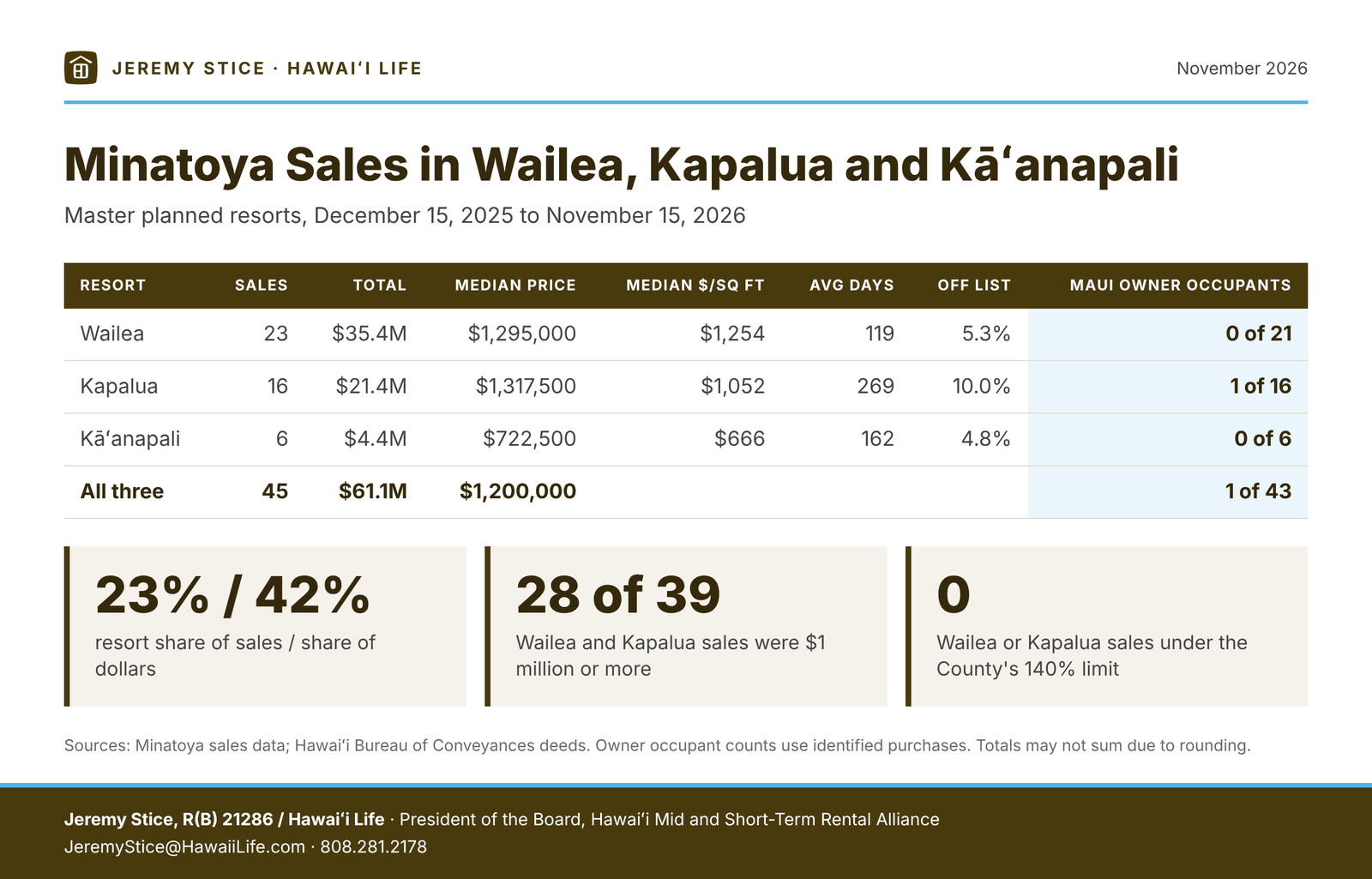
The gap between Bill 9’s goal and the sales is widest in the master planned resorts. Of 45 resort sales, none went to a Maui owner occupant without previous Maui homeownership.
- Wailea: 23 sales, $35.4 million, median $1,295,000. All 21 identified purchases were investor purchases, 19 of them by buyers from outside Hawaii
- Kapalua: 16 sales, $21.4 million, median $1,317,500. Five buyers live in Maui County, and four of them are investors who already own a Maui home. Even the one owner occupant had owned a Maui home before
- Kaanapali: 6 sales, $4.4 million, median $722,500. All six purchases were attributed to buyers outside Hawaii
Resort Maui Minatoya Condos and the County Benchmarks
The resorts account for 23% of sales but 42% of the money. Not one Wailea or Kapalua condo sold below $526,830, the County’s 2025 two bedroom benchmark at 140% of median income. In fact, 28 of their 39 sales were for $1 million or more.
The County’s own Maui Island Plan describes Wailea’s land uses as resort and commercial. It also says an offshore market plays a dominant role in Wailea housing. Resort locations, high carrying costs and prices well above the County’s benchmarks all play a part. As a result, these resort Maui Minatoya condos are a hard fit for local housing.
I will go deeper on the resort numbers in a later post in this series.
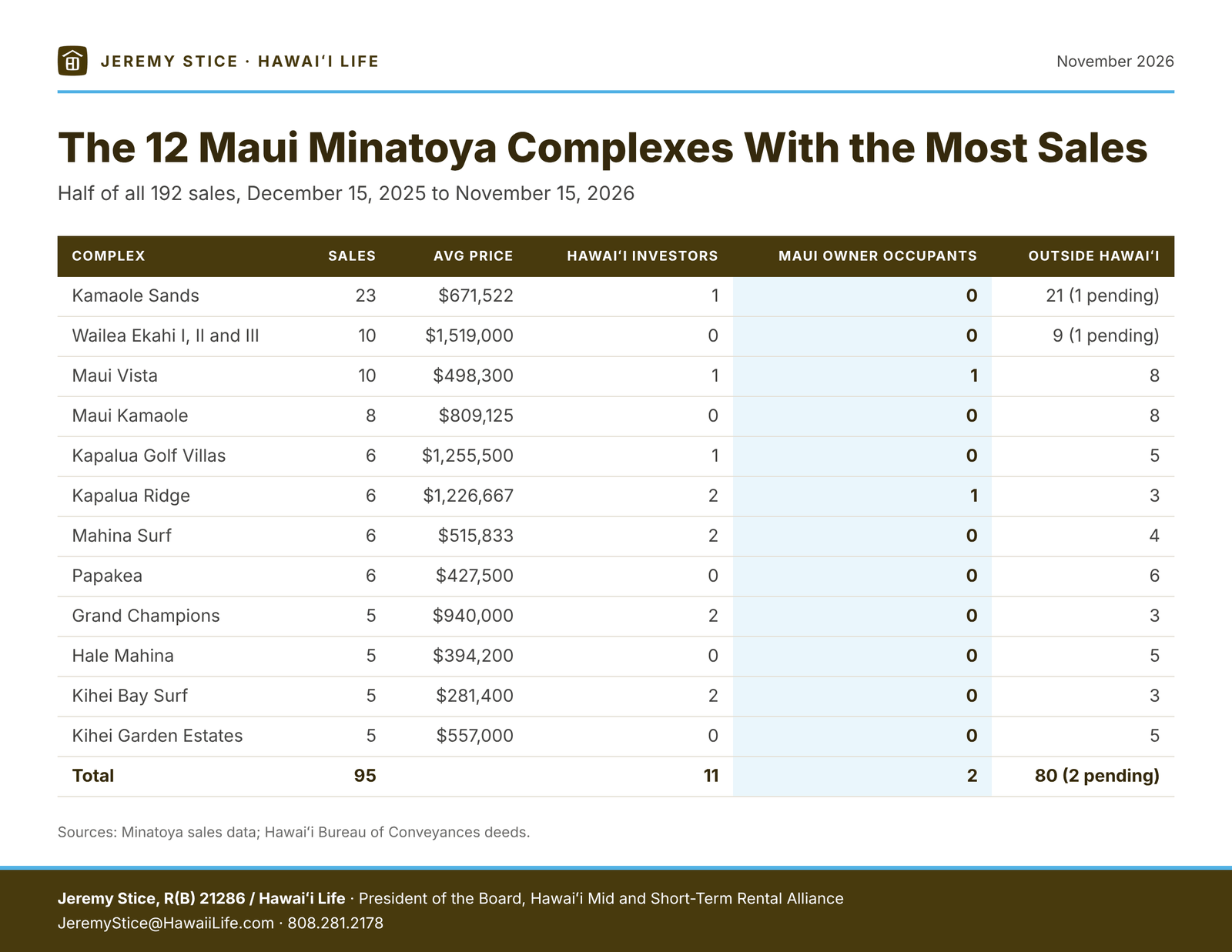
The Maui Complexes With the Most Minatoya Sales
A dozen complexes account for half of all sales. Of the 95 sales in those twelve complexes, 2 went to Maui owner occupants.
Where the Minatoya Discount Went on Maui
UHERO’s 2026 Housing Factbook found Maui condo prices in 2025 were down 11% from 2023. Minatoya condos were down 16%. UHERO attributed the sharper drop to the County’s decision.
In the 13 complexes I tracked in the MLS, the median price of Maui Minatoya condos fell 35%. It went from $1,055,000 to $685,000, comparing December 2022 to November 2023 with December 2025 to November 2026. For example, at Kamaole Sands, the median went from $950,000 to $637,500. Medians move with the mix of units that sell, but a drop of roughly a third is hard to miss. The broader Maui County condo median fell 32%, from $920,000 in October 2024 to $625,750 in October 2025. That covers all condos, though, and other forces were at work too: interest rates, insurance and rising association dues.
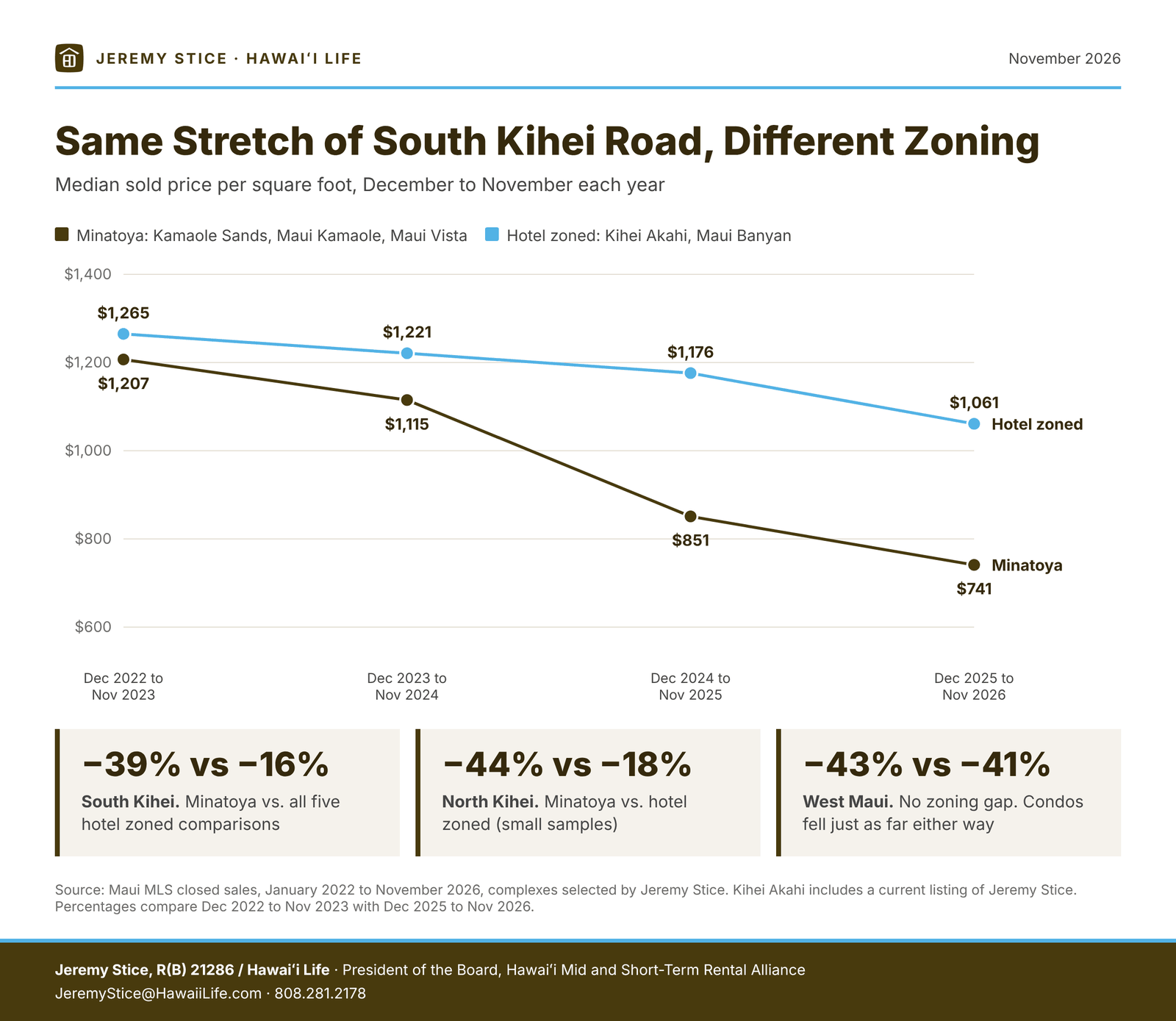
Same Stretch of South Kihei Road, Different Zoning
One useful way to look at Bill 9’s effect is a side by side comparison. It sets Maui Minatoya condos next to hotel zoned condos on the same stretch of road. These nearby buildings share many of the same market pressures, while facing materially different vacation rental rules. They also differ in age, amenities, ocean proximity, association finances and unit mix. So this comparison is observational and cannot control for every difference.
Price per Square Foot by Zoning, 2022 to 2026
I pulled the MLS sales for both from January 2022 to November 2026. Then I compared median sold price per square foot, December 2022 to November 2023 against December 2025 to November 2026:
- South Kihei: Kamaole Sands, Maui Kamaole and Maui Vista fell 39%, from $1,207 to $741 a square foot. By contrast, five nearby hotel zoned buildings fell 16%. Kihei Akahi and Maui Banyan are the two closest comparisons, on the mauka side of South Kihei Road. They went from $1,265 to $1,061
- North Kihei: Kihei Bay Surf and Kihei Garden Estates fell 44%. Meanwhile, Menehune Shores, Koa Lagoon and Kihei Kai fell 18%. The samples here are small, so treat these as directional
- West Maui: Papakea, Mahina Surf and Hale Mahina fell 43%. Similarly, Valley Isle Resort, Royal Kahana and Hololani fell 41%. There is no zoning gap here, and I would be misleading you to claim otherwise. All three hotel zoned comparisons sit on Kahana Bay. There, shoreline erosion and the uncertainty around it have weighed on values for years. Royal Kahana has also been going through major building work. The MLS backs this up: every Hololani sale that answered the question reported a special assessment, 14 of 14. Add the hard years since the fire, and West Maui simply does not offer a clean comparison
What the Kihei Comparison Says About Maui Minatoya Condos
In my read, the extra 23 to 26 points of decline in these Kihei Minatoya complexes is telling. It is among the strongest market signals of the financial uncertainty tied to Bill 9. Still, the comparison cannot isolate the ordinance’s precise financial impact. The West Maui result is a useful reminder that zoning is not the only factor moving values.
Full disclosure: Kihei Akahi is one of the comparison buildings, and I have a listing there. The South Kihei result holds with or without it.
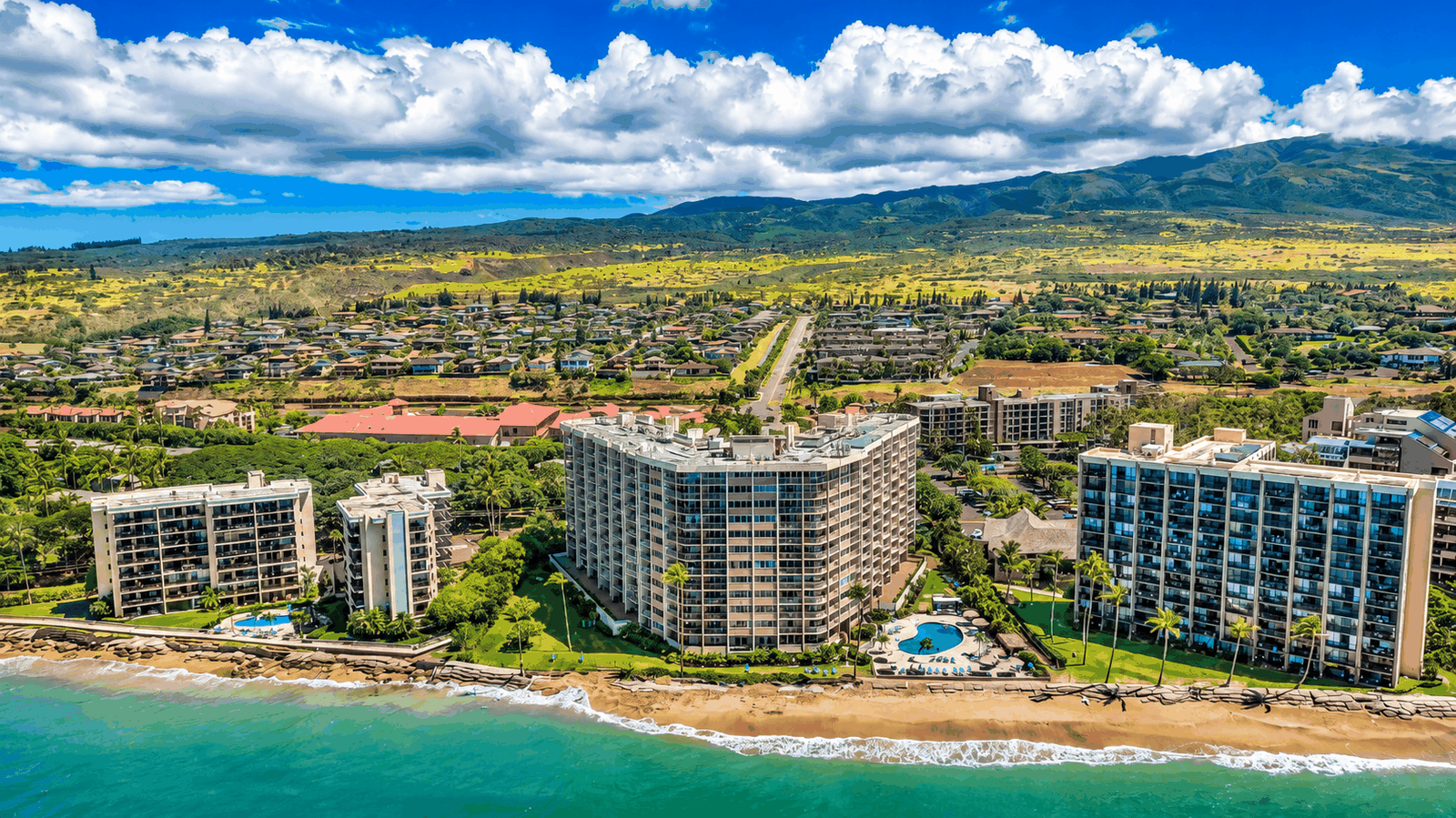
A Hotel Zoned Option on South Kihei Road: Kihei Akahi D402
Some buyers want vacation rental rights that sit outside Bill 9. For them, Kihei Akahi is the clearest example in this comparison.
Kihei Akahi D402 is offered at $925,000. It is a remodeled 2 bedroom, 2 bath, 932 square foot ocean view corner unit on the fourth floor. It sits directly across South Kihei Road from Kamaole Beach Park II. Kihei Akahi is hotel zoned, so it sits outside the Bill 9 phase out. The unit is also an active vacation rental today. A buyer should still confirm the unit’s rental authorization and association rules during due diligence. Listed by Jeremy Stice of Hawaii Life.
Many Maui Minatoya condos keep the same physical qualities that made them desirable before Bill 9. However, their long term rental rights, ownership economics and market values have changed substantially.
The discount went mostly to investor and second home buyers:
- 95% of identified purchases were by buyers who already had a home somewhere else
- Every one of the ten deepest discounts, from about 18% to 24% off list, went to an investor
- The $10.4 million sellers gave up off asking went to the buyers. That came on top of the value owners lost before a single offer came in
Maui Sellers Who Sold to Mainland Buyers
At least 19 sellers gave a Maui address. Thirteen of them sold to buyers from outside Hawaii, for $7.6 million. Five sold to Maui buyers, four of them investors, and one sold to a Honolulu investor. In fact, only one Maui seller sold to a Maui owner occupant.
Seven of those thirteen were Lahaina sellers, more than two years after the fire.
None of this is a criticism of those sellers. These sales reflect individual decisions by buyers and sellers under the market conditions of the day. Also, the records do not tell us what led each owner to sell.
In my read, the policy uncertainty has contributed to lower prices for owners who choose or need to sell. Meanwhile, buyers with the financial resources can acquire those properties at reduced values. The early sales suggest that relatively few of the discounted purchase opportunities have turned into Maui resident homeownership. Whether the broader policy produces meaningful increases in long term rental housing remains to be seen.
How I Help Maui Minatoya Owners and Buyers Through Bill 9
The deeds tell the big picture. Your decision comes down to one building, one unit and one set of numbers. That is the part I help with, whether you are ready now or just exploring.
If You Own a Minatoya Condo on Maui
Buyers have the leverage right now, so how you sell matters as much as when.
- A sell or hold analysis for your building. I put your rental income through the deadline next to a realistic sale price today. I also add your carrying costs and your building’s rezoning status. That way you can see both paths side by side before you decide
- Pricing for the buyer who is actually showing up. With 170 average days on market, the listings that sell are priced and presented for today’s buyer. In most of these buildings, that is a second home buyer who does not need the rent
- A clean handoff of future bookings. Guests on the calendar, the Airbnb and Vrbo listing and the management agreement all need a plan before you list. I cover this in my post on how Airbnb and Vrbo handle a vacation rental sale
If You Are Buying a Minatoya Condo or Weighing the Alternatives
- Second home buyers: this is a negotiating market. I help you underwrite the carrying costs with no rental income assumed. I also read the association documents for reserves and special assessments. Finally, I confirm which bookings can stay on the calendar until the deadline
- Buyers who want rental rights that outlast Bill 9: look at hotel zoned buildings. My post on how to rent out a Maui condo in 2026 covers the rental side
- Maui families buying a first home: some Maui Minatoya condos really are within reach for the first time in years. In this market, sellers have been negotiating. Look hard at the dues, the reserves and any special assessments. Also check whether the land is leasehold before you fall in love with the price. Helping local families buy their first home is my favorite part of this job. I would love to help you evaluate your options, whether that is one of these condos or something else. A full guide is coming later in this series
Help for Maui First Time Buyers
Are you a local family weighing one of these Maui Minatoya condos? Then two programs are worth a call before you write an offer:
- Hale Kamaaina Mortgage Program (HHFDC). The state’s first time buyer program, formerly Hula Mae, offers competitive 30 year fixed rate mortgages. It is open to eligible buyers, including buyers of qualifying condos. Down payment assistance may also be available, subject to current program requirements. Check with a participating lender for current terms, income limits and purchase price eligibility
- County of Maui down payment assistance. The County’s Housing Division has offered first time buyer down payment and closing cost grants in past rounds. Ask whether a new round is open. Wildfire impacted households should also ask the Office of Recovery about the Hookumu Hou program. It closed to new applications in September 2025 but still serves approved households
On a condo with $1,100 a month in dues, a lower rate can be what makes the numbers work. I am happy to walk you through how these programs fit a specific unit. I can also connect you with a lender who knows them.
Questions About Your Maui Minatoya Condo
Over my career, I have represented dozens of vacation rental buyers and sellers across Maui. I am always glad to answer a Bill 9 question, with no obligation. A short call is usually the fastest way to get clear on your options.
Want to see what is on the market today? Search Maui condos for sale on Hawaii Life, then send me the ones that catch your eye, please.
Call or text me at 808.281.2178 or email JeremyStice@HawaiiLife.com.
How This Maui Deed Data Was Built and Its Limits
The dataset covers every Minatoya list sale from December 15, 2025 to November 15, 2026. It was built from multiple proprietary realtor CMA reports, less overlaps and properties not on the list. Each buyer and seller was traced through Bureau of Conveyances deeds and County property records. The research also used the state business registry and public listing sites.
How Maui Purchases Were Classified
- Investor: the buyer has a primary residence somewhere else, so the condo is at least a second property. The label covers second home buyers who do not plan to rent as well as buyers who do
- Owner occupant: a Maui resident whose deed or tax record points to the condo as their home. The research found no other property for them
- Recent mainland transplant: a buyer with a Maui mailing address now. The deed or recent records show a mainland address
- Pending: six sales whose deeds had not reached the public index by November 17, 2026
Buyer percentages use the 186 identified purchases. Price figures use all 192 sales. Some buyers bought more than one condo, so counts are purchases.
| Classification | Purchases |
|---|---|
| Investor or second home | 176 |
| Likely Maui owner occupant | 7 |
| Recent mainland transplant living in the unit | 3 |
| Identified purchases | 186 |
| Pending identification | 6 |
| Total sales | 192 |
For geography, the three recent transplants living in their units count among the 155 purchases by buyers outside Hawaii. That is because their deed or recent records show a mainland address. The figures reconcile. The 155 outside Hawaii purchases are 152 investor purchases plus those 3. Then 152 plus the 24 Hawaii investor purchases makes the 176. A fourth recent transplant now lives in Makawao and bought as an investor. That purchase counts among the 24 Hawaii investor purchases.
What This Maui Data Cannot Tell You
- Holdings were found by name search. Property held under other names, LLCs or other counties can be missed, so investor holdings are a floor
- A mailing address is strong evidence of residence, and still short of proof. Buyers were classed as owner occupants only where the deed or tax record pointed to the condo. Also, no other home could be found for them
- Home values are Zillow, Realtor.com or Realtor.ca estimates, or the County assessment for Maui addresses. They provide general context and should not be treated as appraisals or measures of household wealth
- Six sales are not yet traced. If all six were local owner occupants, the local share would still be only 13 of 192, or 6.8%
Dates and Estimates in the Maui Minatoya Condo Data
- Time periods differ by source. The study window is December 15, 2025 to November 15, 2026. However, the CMA reports that supplied the sales run through November 12, 2026. One covers December 15 to June 19, and the other June 23 to November 12. The latest sale in the dataset closed November 12. So any Minatoya sales closing November 13 to 15, or June 20 to 22, are not included. The deed index was checked through November 17, 2026. The MLS export was pulled November 19, 2026, with comparison years running December 15 to November 15
- The 2026 benchmark counts are estimates. The research groups the 192 sales into price bands. Both 2026 140% benchmarks fall inside the $526,831 to $700,000 band of 49 sales. To estimate how many of those 49 sit below each benchmark, I used my MLS sample of 105 Minatoya sales. In that sample’s band, 20 of 22 were at or below $673,200, and 17 of 22 at or below $639,625. The firm figure is that at least 77 of 192 exceeded the 2026 benchmark at either rate
- The deed research measures who bought the condos that sold. It does not measure long term rental conversions or the occupancy of condos that did not sell
Sources
- Multiple proprietary realtor CMA reports covering Minatoya sales, December 15, 2025 to November 12, 2026
- Maui MLS closed sales in 24 Minatoya and hotel zoned complexes, January 2022 to November 2026
- Freddie Mac Primary Mortgage Market Survey, November 19, 2026
- HHFDC, Hale Kamaaina Mortgage Program materials, 2026
- County of Maui, Hookumu Hou program releases, October and November 2026
- Hawaii Bureau of Conveyances deed records, County of Maui real property records and the Hawaii business registry
- County of Maui, 2025 Affordable Sales and Rental Price Guidelines, effective May 1, 2025
- County of Maui, 2026 Affordable Sales and Rental Guidelines, effective June 1, 2026
- UHERO, Economic Analysis of the Proposal to Phase Out Transient Vacation Rentals in Maui County Apartment Districts (March 2025)
- UHERO, The Hawaii Housing Factbook 2026
- Realtors Association of Maui, op ed in Maui Now, October 14, 2026
- Maui Now market reports citing the Realtors Association of Maui, October 2025 and September 2026
- County of Maui, Bill 9 signing release, December 15, 2025
- Office of Hawaiian Affairs testimony and advocacy materials, summer 2026
Frequently Asked Questions About Who Is Buying Maui Minatoya Condos
Who is buying Maui Minatoya condos after Bill 9?
Mostly investor and second home buyers from outside Hawaii. The deed research covers 186 identified purchases of Maui Minatoya condos from December 15, 2025 to November 15, 2026. Of those, 155 (83%) were attributed to buyers outside Hawaii. Also, 176 (95%) were by buyers with a primary home somewhere else. Seven purchases (3.8%) were likely Maui owner occupant purchases.
How many Minatoya condos have sold since Bill 9 passed?
192 Maui Minatoya condos sold from December 15, 2025 to November 15, 2026. Together they sold for $145.0 million, at a median price of $607,500.
Are Minatoya condos affordable for Maui families now?
For many, not yet. Of the 192 sales, 126 exceeded Maui County’s 2025 two bedroom benchmark for households earning 140% of median income. An estimated 80 to 90 exceeded the higher 2026 benchmark. The median 2 bedroom sold for $836,000 and the median 1 bedroom for $550,000. Both are above the 2025 benchmark of $526,830. Monthly maintenance fees also add substantially to the cost of ownership.
Are mainland buyers outbidding locals for Maui condos?
The recorded sales show little evidence of widespread upward pricing pressure. 182 of 192 Maui Minatoya condos sold at or below asking. The average condo sat on the market for 170 days. Sellers also gave up $10.4 million off their list prices. However, the data cannot show how many offers each condo received.
When do Minatoya vacation rentals have to stop under Bill 9?
Bill 9 is now Ordinance 5909. Under it, qualifying Minatoya vacation rentals may generally keep operating through December 31, 2028 in West Maui. Elsewhere in Maui County, the date is December 31, 2030. Both dates are subject to applicable legal and operational requirements. Hotel and resort zoned properties are not affected.
Why are investors still buying Minatoya condos before the deadline?
Qualifying Minatoya vacation rentals may generally keep operating until the deadline. So an investor buying now may get two to four years of rental income at a discounted price. Many buyers are also underwriting Maui Minatoya condos as second homes and do not depend on rental income. Owner occupants can buy and live in these condos today, but few have.
Did Maui Minatoya condo prices fall because of Bill 9?
UHERO’s 2026 Housing Factbook found Maui condo prices in 2025 were down 11% from 2023. Minatoya list condos were down 16%, and UHERO attributed the sharper drop to the County’s decision. In 13 complexes tracked in the MLS, the median price of Maui Minatoya condos fell 35%, from $1,055,000 to $685,000. In South Kihei, Minatoya condos fell about 39% per square foot from late 2022 to late 2026. Nearby hotel zoned condos fell about 16%. Interest rates, insurance and association dues also weighed on prices.
Mahalo,
Jeremy

Leave your opinion here. Please be nice. Your Email address will be kept private, this form is secure and we never spam you.