Artificial intelligence is rapidly changing many industries, and real estate is no exception. One of the most visible ways AI is showing up in property marketing today is through virtually staged listing photos.
How AI Is Changing Real Estate Marketing
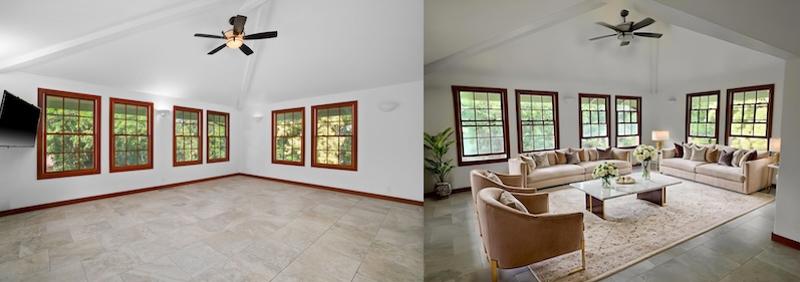
If you’re looking to buy a home on Kauai and you’ve been browsing homes online recently, you may have noticed photos where an empty room suddenly appears beautifully furnished — complete with sofas, rugs, artwork, and décor. In many cases, those furnishings aren’t physically in the home at all. Instead, they’ve been digitally added using AI or virtual staging software.
What Is Virtual Staging?
Virtual staging is the process of digitally adding furniture and decor to photos of empty rooms. The goal is to help buyers visualize how a space might look when furnished.
Why Virtual Staging Can Help Buyers Visualize a Space
For some buyers, empty rooms can sometimes feel smaller, colder, or harder to understand when viewing photos online. Even as I Realtor, I sometimes have a hard time visualizing what a room can be or how wonderful it could look. On occasion, I add virtual furniture, to better communicate the scale, layout, and potential use of a space. When I use virtual staging, blank great room suddenly becomes a welcoming gathering space. An outdoor lanai can be staged to visualize an amazing outdoor living space. Virtual staging can help me and potential buyers imagine the possibilities.
The Rules for Virtual Staging in Hawai‘i
Virtual staging is legal in Hawai‘i, but there are important rules that real estate professionals must follow.
The key is transparency.
If an image has been digitally altered — whether furniture has been added, removed, or modified — it must be clearly disclosed so that buyers understand they are viewing a conceptual image rather than the property exactly as it exists today.
Our MLS systems require that any virtually staged photo be clearly labeled as “virtually staged” or “digitally enhanced.” This disclosure ensures that buyers understand the furnishings are not physically present in the home. In addition, the original photo without furniture must also be included.
The purpose of virtual staging should always be to help buyers visualize the space — not to misrepresent the property.
Virtual staging must never be used to misrepresent the property.
Altering permanent features, hiding defects, or changing structural elements such as windows, walls, flooring, landscaping, or views could be considered misleading advertising and a violation of real estate rules and regulations.
When Virtual Staging Works Well
I believe, when used thoughtfully, virtual staging can be a very helpful tool — particularly for vacant homes or unique spaces. Adding furniture can spark ideas about how the space could be used.
Here is my most recent listing with a few virtually staged photos.
I’d love to hear your thoughts — do you appreciate virtual staging?

Leave your opinion here. Please be nice. Your Email address will be kept private, this form is secure and we never spam you.