More Than 160,000 Pounds Washed Up On Kauai Last Year. Most Of It Wasn’t Ours.
That is what Surfrider Kauai volunteers pulled off the island’s beaches and coastline in 2025. Eighty tons. Roughly 4,700 people showed up to do it.
Here’s the part that surprised me: most of it is not from Kauai.
How Trash Finds Kauai
Kauai sits at the edge of the North Pacific gyre, a slow rotating current system that gathers floating debris and concentrates it. Ocean conditions push that concentration north or south and when it moves closer to the islands, our windward shores catch it.
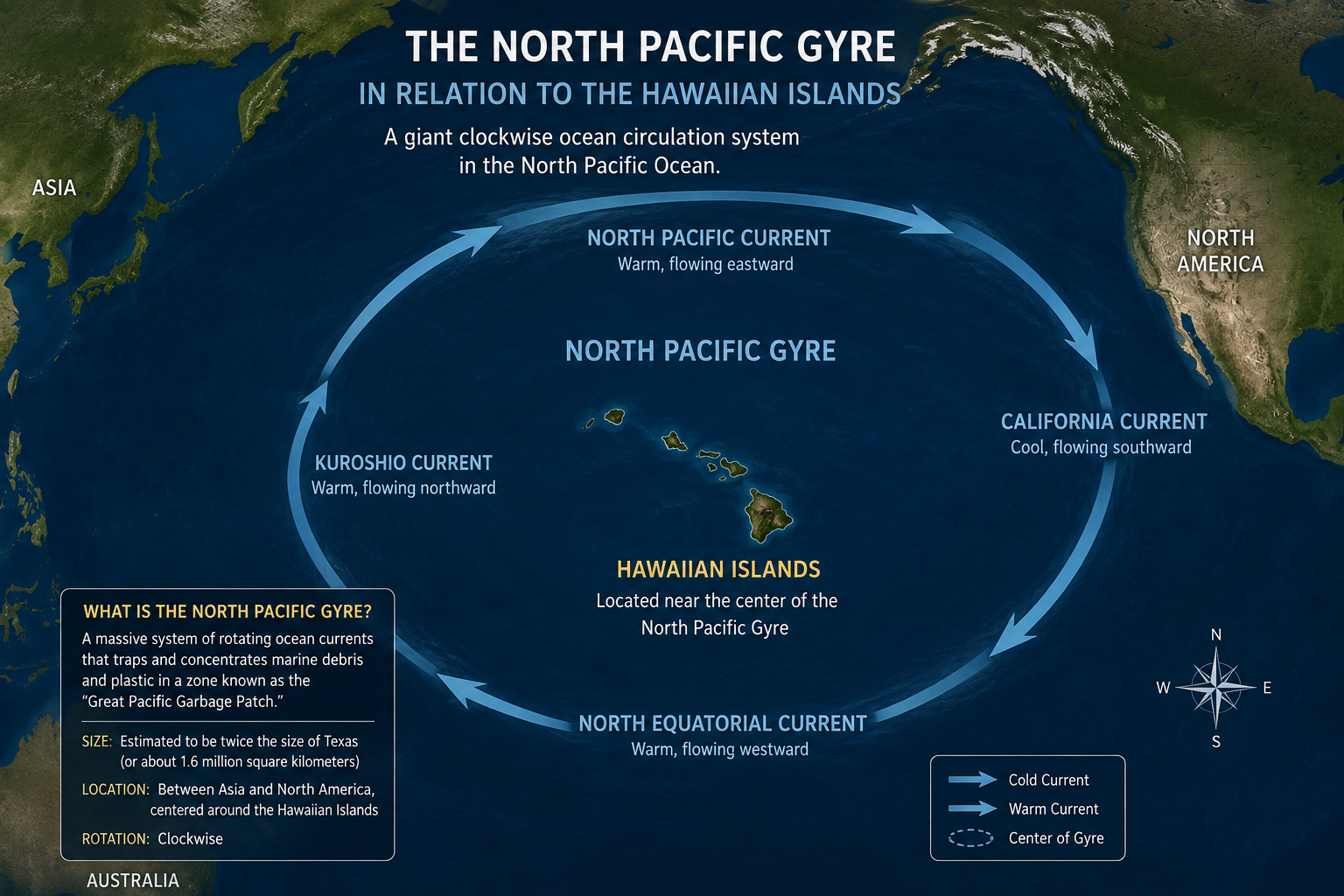
Researchers from Surfrider Kauai, the Hawaii Wildlife Fund and the University of Hawaii studied ten years of removal data from Kauai and Hawaii island and found exactly that pattern. How much debris lands here in a given year tracks with where the garbage patch has drifted.
About 60% of what comes ashore is ghost nets, the silent killers of our oceans. These are lost or abandoned or otherwise discarded commercial fishing gear, some of it in tangled masses over a thousand pounds. Nets are extremely dangerous for several reasons. They never stop fishing, meaning they trap fish, turtles, sharks, dolphins and birds. When a lost net catches small fish, it lures bigger predators that also get stuck. The heavy net eventually sinks, decays a bit and then floats back up to start catching animals all over again. They’re made out of tough materials, like nylon that do not break down easily and can last in the water for hundreds of years. Drifting nets snag on coral reefs and rocky areas, tearing coral apart and polluting shorelines.
Volunteers hike into places with no road access, cut it apart and haul it out, mostly by hand. It can be loaded into 250 pound sacks and lifted out by helicopter because there’s no other way.
So when someone drops a bottle on a beach in another hemisphere, it doesn’t disappear. It gets in line.
What the Ocean Does for Us
We tend to think of the ocean as beautiful scenery. It is closer to infrastructure.
It makes the air. Phytoplankton, the microscopic drifting organisms at the base of the marine food web, are estimated to produce around half of the oxygen in Earth’s atmosphere. Roughly every other breath.
It runs the climate. The ocean absorbs enormous amounts of heat and carbon dioxide and moves that heat around the planet through currents. That system is what determines rainfall patterns, storm behavior and temperature almost everywhere, including Kauai.
It feeds people. The food web starts with plankton. Plankton feed small fish. Small fish feed bigger fish. The ahi or ono on your plate is the far end of a chain that starts with something too small to see. Weaken the base of that chain and everything above it follows.
On Kauai, it also holds the land in place. A healthy reef breaks wave energy before it reaches shore. Degrade the reef and you change how the coastline behaves in heavy surf. This shows up in erosion rates, eventually in setback calculations and in what is standing after a bad storm.
Local Pollution
The gyre delivers most of the weight. Local pollution is the part we can control.
Cesspools. Hawaii has roughly 88,000 of them, and about 14,000 are on Kauai. Statewide they release an estimated 53 million gallons of untreated sewage into the ground every day. That waste moves through groundwater to streams and nearshore water, where the nutrients feed algae that smothers coral and the bacteria ends up where people swim.
Act 125, passed in 2017, requires every cesspool in the state to be upgraded, converted, or connected to sewer before January 1, 2050. Whether that deadline is realistic is genuinely debated. What is not debated is the volume going into the ground while we sort it out.
Smoking. Nationally, smoking related waste made up 25% of every item catalogued in Surfrider cleanups. Cigarette butts, lighters, packaging, disposable vapes. Small enough to feel like nothing. Common enough to be a quarter of everything.
Plastic. Plastic in the ocean does not go away. It breaks into smaller and smaller pieces until it is small enough to be eaten by something small, which is eaten by something larger, and so on up a chain.
Fishing gear. Lost line, leader, and net are the hardest debris on wildlife because they are built to be strong and nearly invisible in water. Hawaii Pacific University researchers found that entanglement in fishing gear is the leading cause of injury to Hawaiian green sea turtles. Hawaii Marine Animal Response has reported that roughly 40% of its monk seal rescues and 25% of its sea turtle rescues involve recreational gear. Net draped over coral can kill the whole head.
What We Can Do for the Ocean
Show up to a cleanup. Surfrider Kauai runs them weekly and welcomes visitors to volunteer as well. You can find more information at kauai.surfrider.org. Remove everything you take to the beach and pick up a few extras while you’re there.
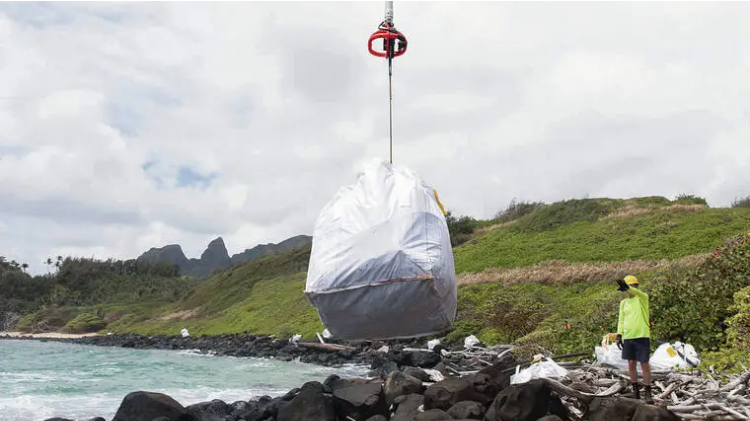
On August 19, 2026, the organization held their 8th Operation Airlift with Hawaii Wildlife Fund and with the help of Jack Harter Helicopters removing nearly 1.8 tons of plastic pollution from Kauai’s coastline.
Secure your bins and your truck bed. A surprising amount of roadside trash on this island is unsecured waste on the way to the landfill.
Deal with your cesspool. If you have one, earlier is cheaper than later. Kauai County offers grants and your next chance to apply for one is coming up! The Residential Cesspool Conversion Grant Program will open on September 8, 2026 and will close on October 6, 2026. If you were waitlisted in the first round, you have to reapply. State tax credits for conversion have come and gone, so check what’s currently available.
Skip the single use item. The unglamorous one that actually moves the number. Most of what turns up on a beach was used once, for a few minutes. Water bottles and their caps, food wrappers, foam containers, lids, straws, bags. None of it was built to last and yet all of it does.
If you fish, don’t leave anything behind. Fishing line is one of the worst things in the water for turtles and monk seals. They can’t see it, it doesn’t break down and can last for hundreds of years. In the meantime, it holds its strength, keeps its loops and stays sharp enough to cut into a flipper or a neck as an animal grows. Rope, hooks and nets do the same kind of harm and all of it outlasts us.
There are places to put it. Surfrider and the state Division of Boating and Ocean Recreation put ocean debris bins in at Nawiliwili and Port Allen in December 2020, then added Waikaea boat ramp and Kikiaola harbor. In the first year the first two collected 960 pounds of rope and net and another 80 pounds of fishing line. The bins themselves are repurposed fish totes that washed up on this island. Use them for your own scrap and for anything you find out there.
Education. Educate yourself, your family and friends about the importance of keeping our oceans, beaches and shorelines free of debris. People who don’t live on an island should know their trash becomes ours.
Something to Consider
There is something clarifying about living on a small piece of land in the middle of a very large ocean.
Everywhere else, it is possible to believe your trash goes somewhere. Here you can watch it arrive. Somebody else’s negligence lands on our sand, gets hauled off a cliff face by a volunteer and the tide brings more.
That could be discouraging and frustrating. It could have the opposite effect because the reverse is also true. What we do here goes out into the same water everyone else is drinking from, breathing from and eating from.
I would love for every flight landing in Hawaii to say three things on approach. Don’t touch the wildlife. Wear reef safe sunscreen. Leave nothing on the beach. Until then, we can start here.
The ocean is not the view from the property. It is the reason the property is livable.

Sylvia Mira Zaradic
September 3, 2026
Loved this article. So much useful information, thank you!
Shannon Genau
September 6, 2026
The ocean is ours to enjoy but it is also ours to help keep clean and protect. It doesn’t pollute itself. Let’s all pitch in people.