Kauaʻi’s September 30 Home Exemption Deadline: What It Saves You and How to File
If Kauaʻi is where you live, the county offers a home exemption that lowers your property taxes and September 30 is the date to have it filed. It is one page, you file it once and it stays with you for as long as the home is yours.
This is a good time of year to pull up your tax bill and make sure everything on it reflects how you actually use your property. Small things get missed during a move or a purchase and this is the time to catch them.
A Little History Worth Knowing
The home exemption is one of the oldest pieces of property law in Hawaiʻi. It was created in 1896 to provide tax relief, encourage home ownership, and support people putting down roots here. The exemption amount that first year was $300. It is still doing the same job today, just at a considerably larger number.
What the Exemption Does
Two things.
First, the county subtracts $220,000 from your assessed value before it calculates anything. That number rises to $240,000 once you turn 60, and $260,000 at 70, and those increases happen automatically once you are in the system.
Second, and this is the larger piece, it places you in the Owner-Occupied classification, which carries the lowest tax rate the county sets.
How Classification Works on Kauaʻi
Your rate is based on how the property is used, not how it is zoned. Here are the current rates for the tax year running July 1, 2026 through June 30, 2027, per $1,000 of net assessed value:
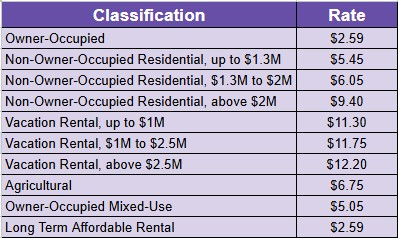
Two things stand out. Owner-Occupied at $2.59 is by a good margin the most favorable rate on the list. And Long Term Affordable Rental sits at the same $2.59, which is the county deliberately rewarding owners who keep housing available year-round for residents.
One note on timing that trips people up. An exemption filed by this September 30 takes effect for the tax year beginning July 1, 2027, not the one you are in now. The county sets each year’s assessments on October 1 and the following June sets the rates. So filing now is about next year’s bill, which is exactly why it is worth doing before you forget.
What it Looks Like in Dollars
Say your home is assessed at $1,500,000 and you live in it full time.
With the exemption filed, the county takes off $220,000, leaving $1,280,000 taxable at $2.59 per thousand. That comes to about $3,315 a year.
In the Non-Owner-Occupied Residential class, the same home would run about $8,295.
The exemption is worth roughly $4,980 a year to that homeowner and it renews on its own.
At $2,500,000, Owner-Occupied with the exemption comes to about $5,905, compared with roughly $16,020 in the Non-Owner-Occupied Residential class.

Who Qualifies
You do if you own your home on Kauaʻi and live in it as your principal residence, here is what the county is looking for:
- You own and occupy the home as of October 1, the assessment date, and you live there at least 271 days measured from October 1 through September 30.
- Your ownership is recorded at the Bureau of Conveyances in Honolulu on or before September 30.
- You file your claim with the Real Property Division on or before September 30.
- You filed a Hawaiʻi resident tax return (N-11) for the prior year showing a Kauaʻi address. Non-resident and part-year resident returns do not qualify and the county does audit this.
- You can show residency with a valid Hawaiʻi driver’s license or Hawaiʻi State ID. A Resident Alien Green Card with residency claimed only in Hawaiʻi, or military orders assigning you here, also work.
- This is your only home exemption anywhere. Not on another Kauaʻi property, not elsewhere in Hawaiʻi, not in another state, not in another country. Holding more than one results in all of your Kauaʻi exemptions being revoked for those years, with rollback taxes, and you can reapply the following tax year.
- Married couples claim one exemption between them, not one each on separate homes. The exception is a court-ordered separation, in which case each may claim half for up to two years.
- Your property taxes are current. If they are delinquent, the exemption is not allowed unless you have a payment agreement with the Director of Finance and you are meeting its terms.
How to File
Claim your Exemption online here: Claim for Home Exemption or pick up a form from the Real Property Assessment Office at 4444 Rice Street in Lihuʻe by September 30. Once it is on file, it carries forward. You will not need to redo it each year.
A Note for Anyone Who Purchased this Year
Congratulations! One detail worth knowing about the timing.
In Hawaiʻi, closing and recording are the same event. The standard purchase contract defines closing as the date your conveyance documents record at the Bureau of Conveyances, so your recording date is your closing date.
What is worth watching is the runway in front of it. Hawaiʻi is a good funds state, which means all funds need to be with escrow and cleared two business days before recording. If funding slips, recording slips with it. And if the date lands on a weekend or any day the Bureau is closed, it moves to the next available day.
If your closing is set for the last week of September, the timeline is tight and worth a quick conversation with your escrow officer.
Keeping it Accurate Going Forward
If how you use the property changes, the county asks to hear from you within 30 days. That includes moving, renting the home or part of it or using a portion of it for a business.
It is a simple update and it keeps everything clean, which makes life easier later if you ever refinance or sell.
Other Exemptions With the Same Deadline
A few additional programs are available and share the September 30 date:
- Disabled veterans. Veterans with a service-connected disability of 80% or more are exempt from property taxes beyond the $150 minimum.
- Blind, deaf, or totally disabled owners. An additional $50,000 exemption, filed on Form P-6 with physician certification.
- Additional exemption and tax credit tied to household earnings. An extra $120,000 exemption plus a reduced refuse collection fee for qualifying owner-occupants, and a separate credit for very low earning households. Both are refiled annually.
- Home Preservation Limit. Filed annually for owners who meet the county’s criteria.
All of these are detailed on the county’s exemption page and worth reading through if there is any chance one applies to you.
What Your Taxes Support on Kaua’i
Real property taxes are the largest single source of the county’s revenue and they pay for the things that make Kauaʻi work day to day: fire and police, road maintenance, the parks and beach facilities, refuse collection.
Verify Your Classification
Pull up your most recent tax bill and take a look at the classification line. If it says Owner-Occupied and you live there full time, you are in good shape and there is nothing to do.
If it says something else, if you are not sure what you are looking at or you don’t know where to find it, reach out to me and I’d be happy to look it up for you!

Leave your opinion here. Please be nice. Your Email address will be kept private, this form is secure and we never spam you.